

Table of Contents
- What Defines Critical Infrastructure in Healthcare Facilities
- SOCI Act 2018 Healthcare Compliance: What Hospital Operators Must Know
- Hospital Power and Cooling Redundancy: Engineering for Zero Downtime
- Critical Infrastructure Risk Management for Hospitals
- Cybersecurity and Cyber-Physical Systems in Hospital Infrastructure
- Sustainable, Modular, and Human-Centric Infrastructure Design
- Emergency Preparedness and Disaster Recovery Planning
- Conclusion
Last Updated: August 30, 2026
What Defines Critical Infrastructure in Healthcare Facilities
Critical infrastructure design for hospitals is the systematic planning, engineering, and integration of physical and digital systems that must remain operational without interruption to sustain patient care and clinical safety. This encompasses power supply, cooling, water, medical gas, data networks, and the physical fabric of clinical spaces. At Treske Pty Limited, we work with hospital facility managers who understand that a single point of failure in any of these systems is a clinical risk, not merely an operational inconvenience.
Critical infrastructure in healthcare is defined as the assets, systems, and networks whose disruption would have serious impact on patient safety, public health, or delivery of essential services.
Hospitals sit at the intersection of multiple interdependencies: power feeds medical equipment, cooling protects patients and servers, and digital systems govern imaging, medication dispensing, and clinical operations. A failure in one domain can cascade across others with alarming speed. Understanding those dependencies is the starting point for credible infrastructure investment. Facility planning must account for clinical spaces, sterile environments, digital operating rooms, and administrative networks, each demanding a different resilience standard.
SOCI Act 2018 Healthcare Compliance: What Hospital Operators Must Know
The Security of Critical Infrastructure Act 2018 (SOCI Act) was substantially expanded by amendments in 2021 and 2022, bringing hospitals and health infrastructure explicitly within its scope as "critical infrastructure assets." Operators of large public and private hospitals now carry direct obligations under this framework.
The SOCI Act establishes a risk-based approach to protecting assets that, if compromised, would affect public health or safety at national or regional level. For hospital operators, compliance extends beyond IT security teams to facility managers, board-level governance, and infrastructure architects.
Notification Obligations and Risk Management Programs
Responsible entities for critical healthcare assets must maintain a Critical Infrastructure Risk Management Program (CIRMP). This documented, living program identifies hazards, assesses risk, and records mitigation measures in place. The Australian Cyber Security Centre guidance on SOCI obligations outlines mandatory CIRMP content, including physical, cyber, personnel, and supply chain risks as integrated categories.
Operators must report certain cybersecurity incidents to the Australian Signals Directorate within defined timeframes, and serious physical incidents affecting asset availability must be reported to the relevant sector regulator. Risk management programs must be designed into the facility from the outset, not retrofitted after construction. Hazard assessment, asset registers, and response protocols need to be embedded in design documentation.
Hospital Power and Cooling Redundancy: Engineering for Zero Downtime
Most infrastructure failures in hospitals result from inadequate redundancy in everyday systems, a generator that fails to start, a UPS never load-tested, a cooling unit that trips during peak demand. Systematic redundancy design, not hope, is the engineering response.

Operational continuity requires critical systems to fail gracefully through a layered approach: primary supply, automatic transfer switching, uninterruptible power supply bridging, and generator backup, all activating in sequence without manual intervention.
Generator Capacity and Uninterruptible Power Supply Design
Generator capacity must be sized for projected growth over ten to fifteen years, not current connected load. A common mistake is specifying generators based on today's load without accounting for planned digital operating rooms, expanded imaging suites, or new data centre infrastructure. The result is a generator already marginal on commissioning day.
Uninterruptible power supply systems bridge the gap between mains failure and generator startup, typically ten to thirty seconds. For critical clinical equipment, that window must be seamless. UPS design should include N+1 redundancy at minimum, with battery health monitoring integrated into the facility's building management system. Vendor-neutral systems are strongly preferred to avoid single-manufacturer lock-in and supply chain risk.
Ventilation Systems and Clean Air Delivery for Clinical Spaces
Ventilation systems in hospitals carry infection prevention and control functions as critical as any power system. Clean air delivery to operating theatres, intensive care units, and isolation rooms must meet specific air change rates, pressure differentials, and filtration standards defined under Australian Health Facility Guidelines Part D, Infection Prevention and Control.
Design must account for IPC measures at system level: HEPA filtration, positive and negative pressure zoning, and continuous air quality monitoring. Ventilation failure in a surgical suite is a patient safety event. Redundant air handling units and automatic failover are the engineering baseline.
Critical Infrastructure Risk Management for Hospitals
Risk management in hospital infrastructure is an ongoing operational discipline connecting asset management, workforce integration, and service planning into a coherent framework.
The starting point is rigorous hazard assessment: mapping every critical asset, identifying failure modes, assigning likelihood and consequence ratings, and prioritising mitigation investment. This process should repeat on a defined cycle and update whenever significant facility, system, or patient population changes occur.
Hazard Assessment and Supply Chain Resilience
Supply chain resilience deserves particular attention. Single-source dependencies for critical components, whether power equipment, cooling refrigerants, or medical consumables, create systemic vulnerability. Effective mitigation requires identifying those dependencies and either diversifying suppliers or maintaining strategic stock.
For infrastructure components, specify equipment available from multiple vendors, avoid proprietary systems where alternatives exist, and maintain service agreements guaranteeing parts availability within defined timeframes. Treske Pty Limited's technology-agnostic approach preserves procurement flexibility and reduces supply chain exposure across multi-site operations. The CIRMP framework requires supply chain risks to be documented and addressed.
| Risk Domain | Key Hazards | Mitigation Priority |
|---|---|---|
| Power supply | Mains failure, UPS battery degradation, generator fault | High, N+1 redundancy minimum |
| Cooling systems | Chiller failure, refrigerant shortage, peak load overrun | High, automatic failover required |
| Cyber-physical systems | Ransomware, network intrusion, BMS compromise | High, segmentation and monitoring |
| Supply chain | Single-source components, long lead times | Medium-High, dual sourcing strategy |
| Ventilation / IPC | Air handling unit failure, filter breach | High, redundant AHU design |
| Physical security | Unauthorised access to plant rooms, data centres | Medium, access control and audit |
Cybersecurity and Cyber-Physical Systems in Hospital Infrastructure
The boundary between physical and digital systems has collapsed. Building management systems, medical devices, HVAC controls, and clinical networks are now interconnected, creating both operational efficiency and significant security exposure.
Cyber-physical systems in hospitals integrate digital commands with physical outcomes. A compromised BMS can disable cooling; ransomware on clinical systems can render digital operating rooms non-functional. Healthcare has become one of the most targeted sectors globally for ransomware and network intrusion.
Data security requires segmented network architecture isolating operational technology (OT) from information technology (IT) systems, with monitored crossing points. Medical devices should be on isolated VLANs with no direct internet access. BMS and SCADA systems require their own security boundary. The Australian Cyber Security Centre's Information Security Manual provides baseline controls applicable to healthcare critical assets.
Incident response plans must be tested, not just documented. Tabletop exercises including facility managers alongside IT security personnel are the standard regulators expect to see.
Sustainable, Modular, and Human-Centric Infrastructure Design
Forward-looking hospital infrastructure projects are designed around three principles: sustainability, modularity, and the wellbeing of people who work and recover within them.
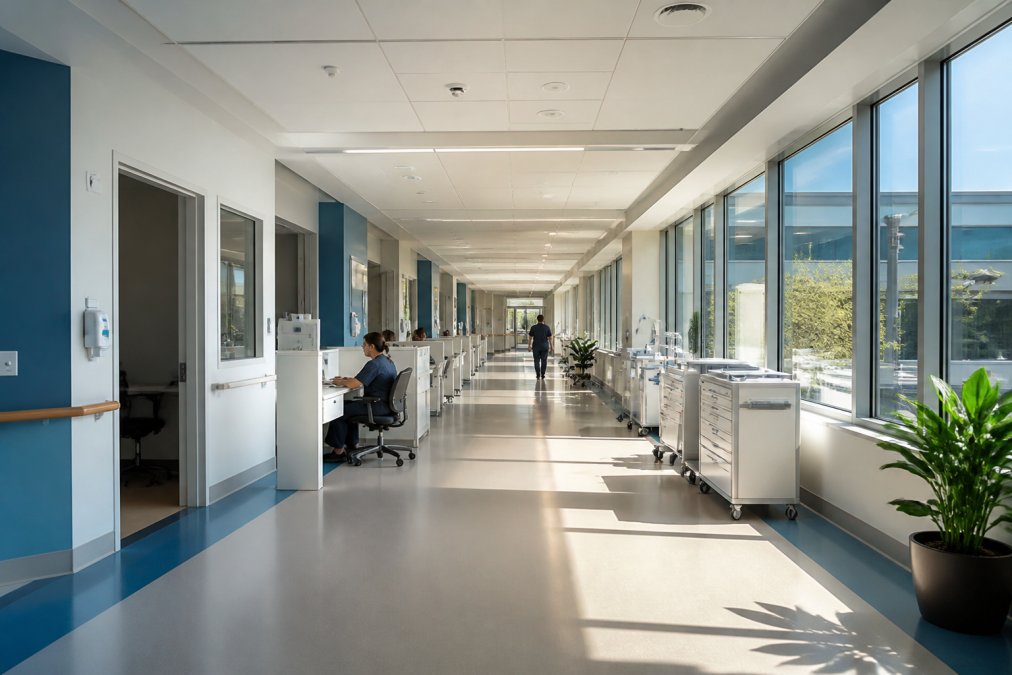
Modular and Scalable Construction for Future-Ready Facilities
Modular construction reshapes healthcare architecture in ways fixed-build facilities cannot match. Prefabricated plant room modules, scalable rack enclosure systems, and standardised power distribution units install with minimal disruption to operating clinical areas.
Scalable design means specifying infrastructure that grows with facility needs without requiring full replacement. A hospital commissioning a 500-bed facility today may need to accommodate expanded ICU, digital pathology, and new imaging within ten years. Infrastructure must absorb that growth without crisis-driven retrofit.
Human-Centric Design for Staff Wellbeing and Operational Continuity
Healthcare architecture directly affects clinical outcomes. Noise levels, lighting quality, thermal comfort, and ergonomic workstation layout affect cognitive performance and staff fatigue. These are operational continuity factors, not aesthetic considerations.
Infrastructure design must account for the working environment of maintenance staff. Plant rooms difficult to access safely, cooling systems creating excessive noise in adjacent clinical areas, and data rooms with inadequate maintenance lighting all create friction over time. Workforce integration into design decisions produces better outcomes than purely technical specifications.
Emergency Preparedness and Disaster Recovery Planning
Emergency preparedness is where critical infrastructure design is ultimately tested. A facility with excellent redundancy and compliant CIRMP will fail if personnel responsible for operating those systems under pressure have not rehearsed scenarios.
Disaster recovery planning must cover three categories: rapid response (first four hours), sustained operations (days to weeks), and recovery (restoring full capability). Each requires different resources, decision-making structures, and pre-positioned assets.
Generator fuel contracts, water storage capacity, and emergency cooling provisions must be specified against realistic worst-case scenarios. Many facilities plan for 72-hour fuel reserves; facilities in complex logistics or high disaster risk areas should plan for longer.
The Australian Institute for Disaster Resilience's hospital resilience guidance provides a structured framework aligning with SOCI Act risk management obligations. Integrating that framework into the facility's CIRMP creates a single, coherent resilience document. Coordination with local emergency services, utility providers, and health authority emergency operations centres must be documented, tested, and maintained as active relationships.
Hospital infrastructure failures do not announce themselves in advance. The gap between rapid recovery and prolonged failure comes down to design quality, risk program rigour, and system reliability. Treske Pty Limited delivers end-to-end critical infrastructure solutions for healthcare facilities, from power and cooling system design through supply, installation, and ongoing maintenance, with a technology-agnostic approach ensuring the right solution for your specific operational environment. Visit us today to discuss your facility's infrastructure requirements.
Frequently Asked Questions
Q: How does the SOCI Act 2018 impact hospital infrastructure design?
A: The Security of Critical Infrastructure Act 2018 classifies hospitals as critical infrastructure assets, requiring responsible entities to maintain a risk management programme, and meet mandatory notification obligations for cyber and physical incidents. These legislative requirements directly shape how hospitals plan power, cooling, data, and physical security systems, making compliance a core design constraint rather than an afterthought.
Q: What are the key requirements for resilient power and cooling in healthcare facilities?
A: Resilient hospital power and cooling design typically requires N+1 or 2N redundancy for critical circuits, generator capacity sized to sustain full clinical operations during a grid outage, uninterruptible power supply systems protecting life-critical equipment, and precision cooling for data and clinical spaces. Ventilation systems must also meet infection prevention and control standards, including positive and negative pressure zoning. Vendor-neutral, agnostic design ensures components from different manufacturers integrate without single points of failure.
Q: What defines 'critical infrastructure' under current national security legislation?
A: Under the Security of Critical Infrastructure Act 2018, critical infrastructure encompasses assets, systems, and networks across 11 sectors whose disruption would have serious consequences for public health, safety, or the economy. Healthcare and medical facilities are explicitly listed, meaning hospitals, pathology labs, and large clinical facilities meet the statutory definition. Responsible entities for these assets carry specific obligations around risk management programmes, incident reporting, and government-directed action in extreme circumstances.
Q: How do you balance sustainability with critical infrastructure reliability in hospitals?
A: Sustainability and reliability are not mutually exclusive in hospital infrastructure design. Energy-efficient cooling technologies, such as precision air systems with variable-speed drives, reduce power consumption without compromising uptime. On-site renewable generation combined with battery storage can supplement grid power and reduce carbon emissions. Modular construction methods allow facilities to expand capacity incrementally, avoiding over-engineering. The key is specifying systems that meet both operational continuity targets and long-term sustainability goals from the design stage.
This article was written using GrandRanker