


Table of Contents
- What Critical Power Infrastructure Installation Services Cover
- UPS Installation and Maintenance: The Backbone of Operational Continuity
- Generator and Automatic Transfer Switch Installation for Emergency Power
- Data Centre Power Infrastructure: Distribution Design and Load Management
- High Voltage Infrastructure Construction and Grid Connection
- What Installation and Commissioning Really Cost
- Sustainability, Security and Lifecycle Cost: The Angles Most Providers Skip
- Frequently Asked Questions
Last Updated: October 17, 2026
What Critical Power Infrastructure Installation Services Cover
Critical power infrastructure installation services in Australia cover the design, supply, installation and commissioning of the systems that keep a facility running when the mains supply fails: UPS systems, backup generators, automatic transfer switches, high voltage connections and the distribution architecture that ties them together.
The scope is wider than most buyers expect. A single project can touch high voltage construction, low voltage distribution, mechanical cooling, rack enclosures and the monitoring layer. Get any one wrong and the whole installation inherits the weakness.
The scope of works in a typical project
A typical engagement runs through five stages, and skipping any of them shifts risk onto the facility manager.
- Site assessment and load study: confirming existing supply capacity, critical loads and physical constraints
- Electrical architecture design: single-line diagrams, redundancy topology, distribution design and protection coordination
- Supply and installation: switchgear, UPS, generators, ATS, cabling, earthing and rack power
The National Construction Code sets the baseline for building compliance, while electrical work itself sits under AS/NZS 3000 and the state-based regulatory framework.
Selection criteria that separate capable providers from order-takers
Ask three questions before signing: can they design as well as install, do they hold in-house licensed electricians or subcontract, and can they prove commissioning with site acceptance testing rather than a signed delivery docket?
UPS Installation and Maintenance: The Backbone of Operational Continuity
An uninterruptible power supply carries the critical load between mains failure and generator start, and it is the component most often installed badly. UPS installation and maintenance covers positioning, input and output connections, battery and bypass arrangements, testing, and the service regime that determines whether the batteries are still capable in year five.
A common mistake is treating the UPS as a plug-in appliance. It is not. Battery autonomy, maintenance bypass provision and monitoring integration all need deciding before the unit arrives on site.
Installation scope, maintenance bypass and commissioning
A proper UPS installation includes site assessment, project management, electrical installation of input, output, bypass, earthing and battery connections, cabling and circuit protection, and commissioning with site acceptance testing.

The maintenance bypass matters more than buyers realise. Our maintenance bypass electrical installation service exists precisely so future UPS servicing or replacement can happen while supply to the critical load continues, where the system design permits.

Battery chemistry, autonomy and redundancy decisions
Three design choices drive most of the cost and risk in a UPS installation, and each needs settling before ordering.
- Battery chemistry: Valve-regulated lead-acid (VRLA) blocks remain the default for most commercial installations because they are sealed, low-maintenance and cheaper upfront. Lithium iron phosphate (LiFePO4) cabinets cost more per kilowatt-hour but tolerate higher ambient temperatures, deliver more usable capacity in a smaller footprint and typically last longer. The trade-off is capital cost, thermal management and monitoring integration.
- Autonomy: Autonomy is the runtime the battery must deliver at the design load, set by the ride-through the site actually needs, not a round number. A site with a reliable generator needs only enough to bridge the transfer and stabilise; a site without one needs autonomy sized to the realistic outage duration. Autonomy falls sharply as load rises, so specifying it at nameplate rather than design load overstates runtime.
- Redundancy topology: A single UPS module is a single point of failure. Parallel redundant (N+1) configurations protect against a module failure, while a full 2N arrangement protects against a failure during maintenance, which is the scenario that catches operators out. Modular UPS frames let capacity and redundancy grow without replacing the whole unit.
Standards and compliance for UPS installations
UPS installation sits within the same layered framework as the rest of the electrical installation. AS/NZS 3000 governs wiring and earthing, AS/NZS 61439 covers the low voltage switchgear and assemblies around the UPS, and the battery installation needs ventilation, fire separation and signage appropriate to the chemistry. Electrical work must be carried out by licensed electricians under the state or territory electrical safety regulator, backed by test results and as-built documentation rather than a delivery docket.
Preventative maintenance that actually prevents outages
Preventative maintenance is scheduled intervention that tests battery capacity, verifies transfer operation and inspects connections before failure occurs. An annual visual inspection is not maintenance; battery impedance testing, thermal scanning of terminations and functional transfer tests are.
A workable regime for most facilities includes:
- Quarterly visual inspection of the UPS, batteries and terminations
- Annual battery impedance or conductance testing, with results trended against commissioning baselines
- Annual thermal scanning of terminals and connections under load
Generator and Automatic Transfer Switch Installation for Emergency Power
Generator and automatic transfer switch installation determines whether backup power arrives in seconds or not at all. The generator supplies the power; the ATS decides when to accept it. Sizing errors and transfer-testing shortcuts are where these systems fail in practice. Proper execution of these technical requirements remains the most significant factor influencing the total home generator installation budget.
Sizing, fuel and load management
Generator sizing starts with the actual load profile, not the nameplate total. Motor starting currents, UPS charging loads and future capacity all affect the figure. Fuel storage needs to cover the realistic outage duration for the site, and load management determines what gets shed when the generator cannot carry everything at once.
Transfer testing and load acceptance
A generator that starts is not a generator that carries load. Load acceptance testing proves the set takes the critical load at the transfer point and runs stable under it. Test the ATS in both directions, confirm transfer and re-transfer times, and document the results.
Data Centre Power Infrastructure: Distribution Design and Load Management
Data centre power infrastructure is the distribution architecture between the incoming supply and the rack: switchboards, busways, PDUs, redundancy topology and the load management that keeps capacity visible.
UPS Electrical Installation Australia →
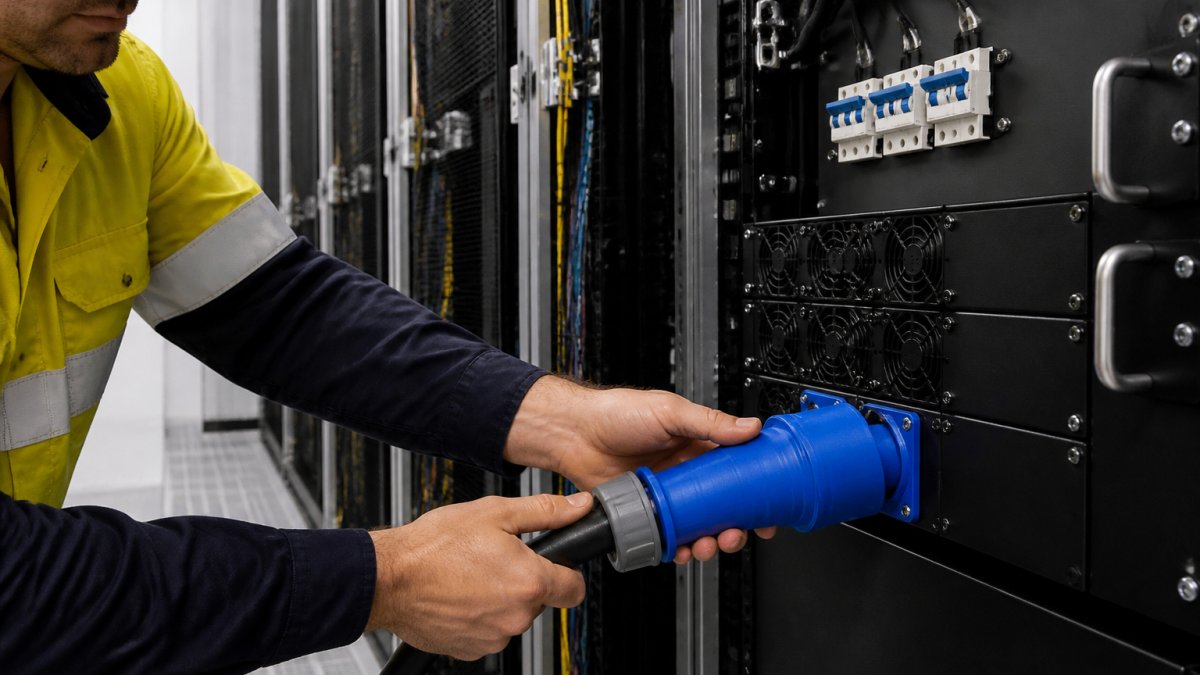
Redundancy is a design decision with a cost attached. N+1 protects against a single failure; 2N protects against a failure during maintenance, the scenario that actually catches operators out.
Our rack and stack UPS service covers on-site installation of UPS, battery modules, external battery modules, bypass and PDUs into an existing rack environment, subject to equipment weight, rack capacity and site access.

High Voltage Infrastructure Construction and Grid Connection
High voltage infrastructure construction covers the assets operating above low voltage: transformers, ring main units, HV switchgear and the connection to the supply authority's network. HV work is licensed, inspected and regulated in a way low voltage work is not, and the grid connection runs on the utility's timetable, not yours.
Compliance with Australian standards and the regulatory framework
Compliance in this space is layered. AS/NZS 3000 governs electrical installations. AS/NZS 61439 covers low voltage switchgear assemblies. HV installation, testing and energisation are restricted to authorised personnel under the state or territory electrical safety regulator, and the connection itself requires approval from the relevant network operator. Safe Work Australia's electrical safety guidance sets out the national model framework those state regulators work within.
What Installation and Commissioning Really Cost
Installation and commissioning costs vary with scope, but published service pricing gives a realistic baseline. The figures below are Treske's own listed prices and represent the service component only, not equipment or major electrical works.
| Service | Listed Price (AUD) | What It Covers |
|---|---|---|
| UPS electrical installation | $1,560.00 | Assessment, project management, input/output/bypass/battery connections, testing, commissioning |
| Rack and stack UPS service (1-3kVA) | $650.00 | On-site rack mounting, battery and EBM install, PDU connection, configuration |
| UPS start-up and commissioning | $1,149.72 | Start-up, functional testing and verification within 100km metro |
| Maintenance bypass installation | Quoted per site | MBS mounting, cabling, UPS integration, functional testing |
| Micro DC series installation | Quoted per site | Concurrent data cabling, electrical and mechanical installation |
Sustainability, Security and Lifecycle Cost: The Angles Most Providers Skip
Three areas separate a resilient installation from a merely compliant one, and most providers address none of them. Each changes the design decisions made at installation time.
Green energy integration and facility resilience
Solar, battery storage and grid-interactive systems change the load profile the critical power design must handle. Integrating renewables without revisiting transfer logic and load management creates a system that behaves unpredictably during outages.
The practical issues are concrete:
- Reverse power and transfer logic: A grid-tied solar inverter shuts down when the mains fails unless designed for island operation. If the generator is to carry the site, the transfer sequence must account for the inverter dropping out and the resulting step change in load.
- Battery storage as a UPS layer: A battery energy storage system can provide ride-through and peak shaving, but it is not automatically a UPS substitute. Transfer time, waveform and autonomy differ, and the critical load still needs a supply that meets its tolerance.
- Load management: Renewables and storage make the load profile more variable, raising the importance of load management and capacity visibility. A design that assumes a stable load will misjudge generator sizing and autonomy once solar and storage are added.
Cyber-physical security convergence
Modern power systems are monitored and controlled through networked systems. That makes the monitoring layer a security boundary. Restrict remote access, segment building management networks from IT networks, and treat UPS and generator controllers as the cyber-based systems they now are.
The installation decisions that matter:
- Network segmentation: Keep the power monitoring network separate from the corporate IT network, with controlled access points rather than flat connectivity.
- Remote access: Vendor remote access for UPS and generator controllers should be time-limited, logged and approved, not a permanent always-on connection.
- Firmware and credentials: Default credentials on controllers and monitoring cards are a common weakness. Change them at commissioning and record the change against the asset register.
Maintenance and lifecycle cost analysis
Lifecycle cost covers batteries, service contracts, generator servicing, testing and eventual replacement. A cheaper installation with no maintenance provision usually costs more over ten years than a higher upfront price with a documented service regime. Our preventative maintenance service and site acceptance testing close that gap.
A total cost of ownership view for a critical power system typically includes:
- Battery replacement: The largest recurring cost for most UPS installations, driven by chemistry, ambient temperature and depth of discharge. Planning replacement on measured capacity avoids both premature spend and unplanned outages.
- Service contracts: Scheduled preventative maintenance, testing and thermal scanning, priced annually rather than left to reactive call-outs.
- Generator servicing: Fuel, filters, coolant and load testing on a schedule that matches the manufacturer's requirements and the site's criticality.
Frequently Asked Questions
What services are included in critical power infrastructure installation?
A full scope typically covers site assessment and electrical architecture design, project management, installation of UPS systems, generators and automatic transfer switches, power distribution and cabling, earthing and protection, commissioning and site acceptance testing, and monitoring integration. It should also include documentation and asset records so the facility team inherits a system they can maintain. Providers that hold in-house licensed electricians can carry a single point of responsibility from planning through to energisation, rather than handing you between subcontractors.
How do I choose a critical power infrastructure installation provider?
Check three things first: licensing and electrical qualifications, whether design and installation sit with the same accountable team, and evidence of commissioning and site acceptance testing on comparable sites. Ask for references in your sector, particularly healthcare or data centre work where operational continuity is non-negotiable. Confirm the provider is genuinely technology-agnostic so the design fits your loads rather than their preferred brand. Finally, ask what ongoing preventative maintenance looks like, because the installation is only the start of the asset lifecycle.
What is the difference between a UPS and a generator?
A UPS carries the load through the first seconds of an outage with no break in supply, then runs long enough for a generator to start and stabilise. A generator provides long-duration emergency power but takes time to come online, so it cannot protect sensitive IT loads on its own. Most critical facilities use both, tied together by an automatic transfer switch. The UPS protects power quality and bridges the gap; the generator provides endurance. Sizing each to the other is part of the electrical architecture design.
How should critical power systems be designed for redundancy?
Redundancy starts with a site assessment that maps every critical load and the consequence of losing it. From there, design decisions cover N+1 or 2N arrangements for UPS modules, dual power paths to racks, automatic transfer switch configuration and maintenance bypass so equipment can be serviced without dropping the load. The goal is facility resilience: no single failure, and no planned maintenance task, should interrupt operational continuity. Document the topology and test it under load during commissioning.
How often should critical power infrastructure be tested and maintained?
Preventative maintenance is usually scheduled at least annually for UPS systems, batteries and transfer switches, with battery impedance and runtime checks more frequent on ageing strings. Generators need regular start and load-bank testing, not just idle runs, so you know they will accept load when asked. Every maintenance visit should produce records you can audit. Testing frequency should reflect the criticality of the load and the manufacturer's requirements, and any site acceptance testing baseline set at commissioning is the benchmark you measure against.