

Table of Contents
- What Data Center Power Commissioning Actually Verifies
- The Five Levels of Data Center Commissioning (L0 to L5)
- Your Data Center Commissioning Checklist, Step by Step
- Power Path Validation: UPS, ATS and Generator Load Bank Testing
- Integrated Systems Testing (IST) Procedures for Power and Cooling
- Data Center Power Testing Duration: How Long Each Stage Takes
- From Commissioning to Operations: Handover, Metrics and Edge Sites
- Frequently Asked Questions
Last Updated: September 20, 2026
What Data Center Power Commissioning Actually Verifies
Power commissioning proves every part of a data centre's electrical system works as designed before it carries live load, the only chance to find faults without an outage.
Here is what the process confirms:
- Design intent matches what was built, not just what was drawn
- Every power path carries load without overheating or tripping
- Redundancy verification proves failover works under real conditions
- Sequence of operations runs correctly across the whole system
The Five Levels of Data Center Commissioning (L0 to L5)
Data centre commissioning runs across five recognised levels, from factory checks to integrated systems testing. Each builds on the last, skip one and the next will not hold:
- L0: Factory acceptance test (FAT). Equipment is tested at the manufacturer before shipping.
- L1: Site acceptance test (SAT). Components are checked on arrival and after installation.
- L2: Pre-functional checks. Visual and mechanical inspections before power-up.
- L3: Functional performance testing (FPT). Each system runs on its own.
- L4: Integrated systems testing (IST). All systems run together under load.
- L5: Operational readiness. Handover to facility operations with live monitoring.
From Factory Acceptance to Integrated Systems Testing
The jump from L0 to L5 is where most schedules slip. A factory acceptance test proves a unit works in a controlled plant, but says nothing about how it behaves once wired into your mechanical cooling loop or building management system. Comprehensive site integration requires rigorous field inspections to verify build quality before the equipment is subjected to the unpredictable stresses of a live electrical environment.
Your Data Center Commissioning Checklist, Step by Step
A working data center commissioning checklist moves from paperwork to live load in a fixed order, the way commissioning authorities do it on real sites.
- Confirm design intent. Review drawings, load calculations and redundancy targets.
- Build the commissioning plan. Set scope, schedule, roles and acceptance criteria.
- Run factory acceptance tests. Witness equipment testing before delivery.
- Complete pre-functional checks. Inspect, clean and torque before power-up.
- Perform point-to-point verification. Confirm every cable and signal lands correctly.
- Run functional performance testing. Test each system under load.
- Carry out integrated systems testing. Prove failover across the whole site.
- Close out the issue tracking log. Fix and retest every open item.
- Hand over to operations. Deliver documentation, training and a performance baseline.
Pre-Functional Checks: What Gets Verified Before Power-Up
A pre-functional checklist catches faults before any circuit is energised. Typical items include:
- Torque values on all busbar and lug connections
- Correct breaker ratings and trip settings
- Cable labelling and point-to-point verification
- Cleanliness inside switchgear and cabinets
- Correct rotation on motors and fans
Power Path Validation: UPS, ATS and Generator Load Bank Testing
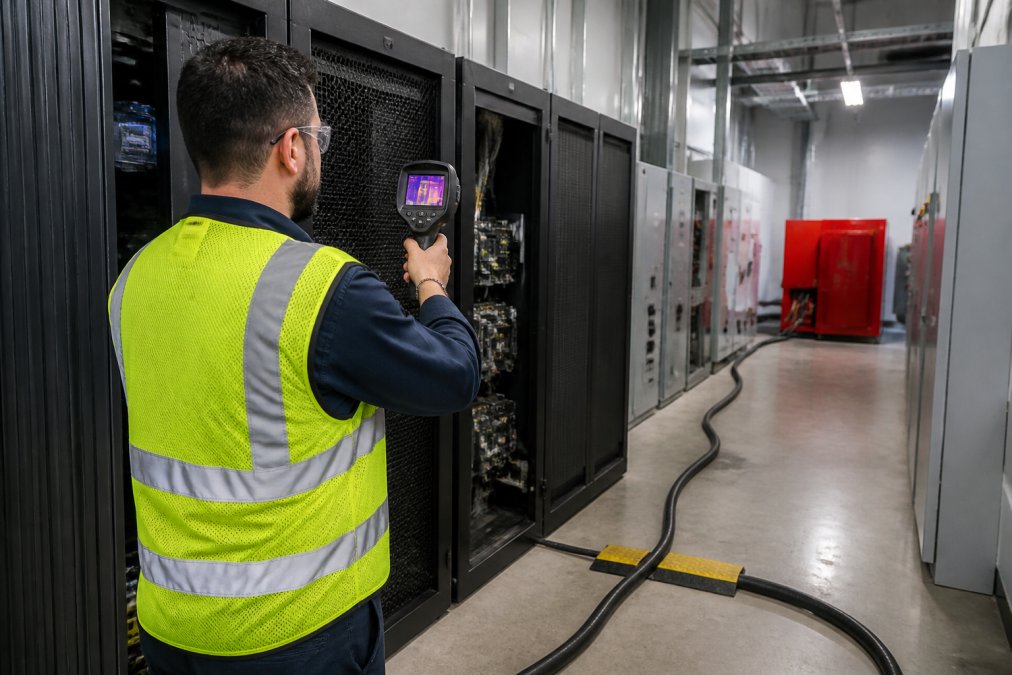
Power path validation proves power reaches the load through every available route, including the backup. It covers the uninterruptible power supply, automatic transfer switch, static transfer switch and standby generator, each tested in isolation, then as part of a live transfer sequence.
UPS Testing: From Battery Discharge to Transfer Time
UPS validation runs through a sequence:
- Battery discharge test. The UPS carries the critical load on battery alone for a defined period, typically 5-15 minutes depending on the design autonomy. Voltage and cell temperature are logged throughout.
- Transfer time measurement. The static transfer switch is timed from fault detection to load pickup. Most designs target a transfer within 4-10 milliseconds for a static switch, and under 100 milliseconds for a mechanical ATS.
- Ride-through verification. The UPS must hold the load through a utility dip without dropping to bypass. This is where a weak battery string or a misconfigured inverter shows up.
- Bypass and maintenance mode. Prove the load can be transferred to maintenance bypass and back without interruption, the step most often skipped because it requires careful sequencing.
Generator Load Bank Testing: Step Profiles and Acceptance Criteria
Load bank testing applies a controlled electrical load to a generator or UPS to prove it performs at rated capacity. Without it, you are trusting a nameplate. A typical test follows a step profile:
- No-load run, confirm stable voltage and frequency at idle.
- 25% load step, check for voltage sag and recovery time.
- 50% load step, monitor exhaust temperature and coolant stability.
- 75% load step, the point where fuel delivery and turbo response are stressed.
- 100% load step, rated capacity held for a sustained period, often 30-60 minutes.
- 110% overload, a short-duration test to prove the generator can ride through a transient without tripping.
ATS and Static Transfer Switch Testing
The automatic transfer switch is tested by simulating a utility loss and confirming the generator picks up load within the designed window. The static transfer switch is tested separately, a semiconductor bridge that must switch fast enough to keep IT equipment alive. Key checks:
- Source preference and return. Confirm the ATS returns to utility only after the generator has cooled and the utility has been stable for a set period.
- Manual transfer. Prove an operator can transfer the load by hand if the automatic logic fails.
- Interlock verification. Confirm the ATS cannot connect utility and generator simultaneously, a mechanical and electrical interlock check that is easy to assume and dangerous to skip.
Integrated Systems Testing (IST) Procedures for Power and Cooling
Integrated systems testing proves power and cooling work together under fault conditions, the highest-stakes part of the schedule.
IST procedures typically cover:
- Failover testing between utility supply and generator
- UPS ride-through during a transfer
- Chiller plant restart after a power event
- Cooling recovery time after a thermal upset
- BMS alarms and control responses
Data Center Power Testing Duration: How Long Each Stage Takes
Power testing duration depends on site size and complexity, but the pattern is predictable, most time goes into preparation, not the test.
Stage |
Typical Duration |
Main Driver |
|---|---|---|
Pre-functional checks |
1-2 weeks |
Number of circuits and panels |
Point-to-point verification |
1-3 weeks |
Cable count and terminations |
Functional performance testing |
2-4 weeks |
System count and load steps |
Generator load bank testing |
2-5 days |
Generator size and load steps |
Integrated systems testing |
1-2 weeks |
Redundancy paths and failover scripts |
Close-out and handover |
1-2 weeks |
Open items in the issue log |
What Extends a Commissioning Schedule
Schedules slip for repeat reasons, the biggest being late equipment delivery, which pushes every downstream test back. Other causes:
- Design changes made after L2 checks begin
- Incomplete pre-functional checklist sign-offs
- Open items left in the issue tracking log at L4
- Utility connection delays for the standby generator
Fix the small items early. They compound.
From Commissioning to Operations: Handover, Metrics and Edge Sites
Handover is where commissioning either pays off or falls apart. A site that passes L4 but hands over with no documentation leaves operations blind, and turning test results into a facility that stays reliable for a decade is harder still.
The Handover Package: What Operations Actually Needs
A proper handover includes:
- As-built drawings and test records
- A performance baseline for future comparison
- Training for facility operations staff
- A maintenance schedule tied to real test data
But the package itself is not the handover. The handover is the transfer of judgement. The commissioning authority has spent weeks learning how this specific site behaves under fault. That knowledge is not in the drawings.
A practical handover session should cover:
- Known weaknesses. Every site has one or two components that performed marginally during testing. Operations needs to know which ones and what to watch.
- Test data walkthrough. Not just the pass/fail result, but the actual curves, transfer times, temperature rises, recovery durations. These become the reference for future maintenance.
- Failure scenarios. Walk the FM team through the same fault scripts used in IST, so they recognise the sequence when it happens for real.
- Escalation paths. Who to call when a generator fails to start at 2am, and what the first three diagnostic steps are.
Post-Commissioning Maintenance Handover: Bridging the Gap
Post-commissioning maintenance handover matters most here. Without it, the first fault after go-live becomes a firefight.
What to monitor in the first 90 days:
- UPS battery string voltage, a weak cell shows up as a drift within weeks.
- Generator start time, if it creeps up, the battery or fuel system is degrading.
- Cooling recovery time, a slow recovery after a thermal upset points to a refrigerant or airflow issue.
- Power Usage Effectiveness (PUE), the ratio of total facility power to IT power. A rising PUE after go-live often means cooling is working harder than it should.
Edge Data Centres: A Lighter Version of the Same Process
Edge data centres need a lighter version of the same process, smaller footprint, same core checks on power, cooling and failover. The practical differences:
- No on-site operations staff. Edge sites are often unmanned, so remote monitoring and automated alerting replace the daily walk-through.
- Smaller load banks. A single portable load bank may cover the whole site rather than a trailer-mounted unit per generator.
- Simplified IST. With fewer systems, the integration test is shorter, but the failover logic still needs to be proven.
- Remote handover. Training may be delivered remotely, which means the documentation has to be more self-contained.
Automated Commissioning Tools: What They Do and Do Not Replace
Automated commissioning tools capture test data straight into the issue log, cutting manual transcription errors, but they do not replace the commissioning authority's judgement.
What they are good at:
- Continuous logging of voltage, current, temperature and transfer times during tests.
- Automatic comparison against the design baseline, flagging out-of-tolerance results in real time.
- Traceable records that feed directly into the handover package.
What they cannot do:
- Decide whether a marginal result is acceptable given the site's specific risk profile.
- Interpret an unexpected interaction between systems.
- Sign off on a test.
Frequently Asked Questions
What are the 5 levels of data center commissioning?
The five levels run from L1 to L5. L1 covers factory acceptance testing before equipment ships. L2 verifies individual components on site, such as point-to-point checks and pre-functional inspections. L3 tests systems in isolation, including load bank testing of generators and UPS units. L4 proves integrated systems testing, where the power path and mechanical cooling loop respond together under fault conditions. L5 covers operational readiness and post-occupancy validation, confirming the facility performs to design intent with live IT load.
How long does data center power testing take?
Timelines depend on facility size and redundancy configuration. Pre-functional verification of a single power path often takes one to three days. Generator load bank testing typically runs several hours per unit. Integrated systems testing of a full power path, including failover testing between the utility supply, standby generator and uninterruptible power supply, commonly spans two to five days. Larger sites with multiple switchboards and static transfer switches extend further, so build contingency into the commissioning plan.
What should a data center commissioning checklist include?
A practical checklist covers pre-functional verification of switchgear, power distribution units and automatic transfer switches; point-to-point wiring checks; thermal imaging of terminations under load; UPS battery and runtime verification; generator load bank testing at stepped loads; redundancy verification through deliberate failover; and an issue tracking log with closeout sign-off. It should also capture sequence of operations confirmation, building management system alarms, and the performance baseline recorded for future comparison.
Why is integrated systems testing critical for power infrastructure?
Component tests prove each item works alone. Integrated systems testing proves they work together when something fails. A generator that starts cleanly on its own may still fail to carry load if the automatic transfer switch timing conflicts with the UPS ride-through window. IST scripts simulate real faults, such as utility loss, chiller failure or a static transfer switch operation, and verify the sequence of operations end to end. It is the only stage that validates true operational readiness before live IT load.
A commissioning schedule that runs long or misses a fault path puts your whole site at risk. Treske Pty Limited designs, supplies and installs power, cooling and rack systems with an agnostic approach to technology, so the solution fits your site rather than a vendor's catalogue. Our team handles commissioning, site acceptance testing and ongoing preventative maintenance across Australia and New Zealand. Get started with Treske Pty Limited and prove your power path before it carries live load.