

Table of Contents
- Quick Comparison: Data Center Cooling Solutions at a Glance
- How We Evaluated These Cooling Solutions
- 1. Vertiv Liebert CRV4: Best for High-Density Rack Rows
- 2. Vertiv Liebert DM 22-27kW: Best for Small to Medium Computer Rooms
- 3. Stulz Minispace 6-32kW: Best for Retrofitting Existing Server Rooms
- 4. Rittal All-in-One Micro Data Center: Best Liquid-Cooled Edge Unit
- 5. Vertiv SmartRow and SmartCabinet: Best All-in-One Contained Solutions
- 6. APC NetShelter Aisle Containment: Best Airflow Upgrade for Legacy Halls
- Choosing the Right Cooling Infrastructure
- Frequently Asked Questions
Last Updated: September 25, 2026
Quick Comparison: Data Center Cooling Solutions at a Glance
Data center cooling is the controlled removal of heat generated by IT equipment to keep servers within safe operating temperatures. Picking the right system in 2026 means matching cooling capacity to rack density, room size, and whether you are building new or retrofitting. This guide from Treske Pty Limited covers the six best data center cooling solutions for 2026.
| Solution | Cooling Capacity | Best For | Form Factor |
|---|---|---|---|
| Vertiv Liebert CRV4 | 12-66 kW | High-density rack rows | In-row |
| Vertiv Liebert DM 22-27kW | 22-27 kW | Small to medium computer rooms | Room unit |
| Stulz Minispace 6-32kW | 6-32 kW | Retrofitting existing server rooms | Downflow/upflow |
| Rittal All-in-One Micro DC | 3-6.5 kW | Liquid-cooled edge deployments | Single rack |
| Vertiv SmartRow/SmartCabinet | Up to 40kVA | All-in-one contained solutions | 1-8 racks |
| APC NetShelter Aisle Containment | N/A | Airflow upgrade for legacy halls | Containment |
How We Evaluated These Cooling Solutions
We assessed each system against four criteria: cooling capacity range, energy efficiency, retrofit friendliness, and ongoing maintenance demands.

The evaluation weighted three practical factors heavily:
- Thermal load match - does the unit's capacity range actually cover your rack density?
- Retrofit disruption - can it be installed without taking the room offline?
- Operational cost - energy draw, filter changes, and service access
1. Vertiv Liebert CRV4: Best for High-Density Rack Rows
The Vertiv Liebert CRV4 is the strongest pick for high-density rack rows because it sits directly in the row and cools heat at its source. Capacities run from roughly 12 kW to 66 kW, supporting rack loads above 8 kW.

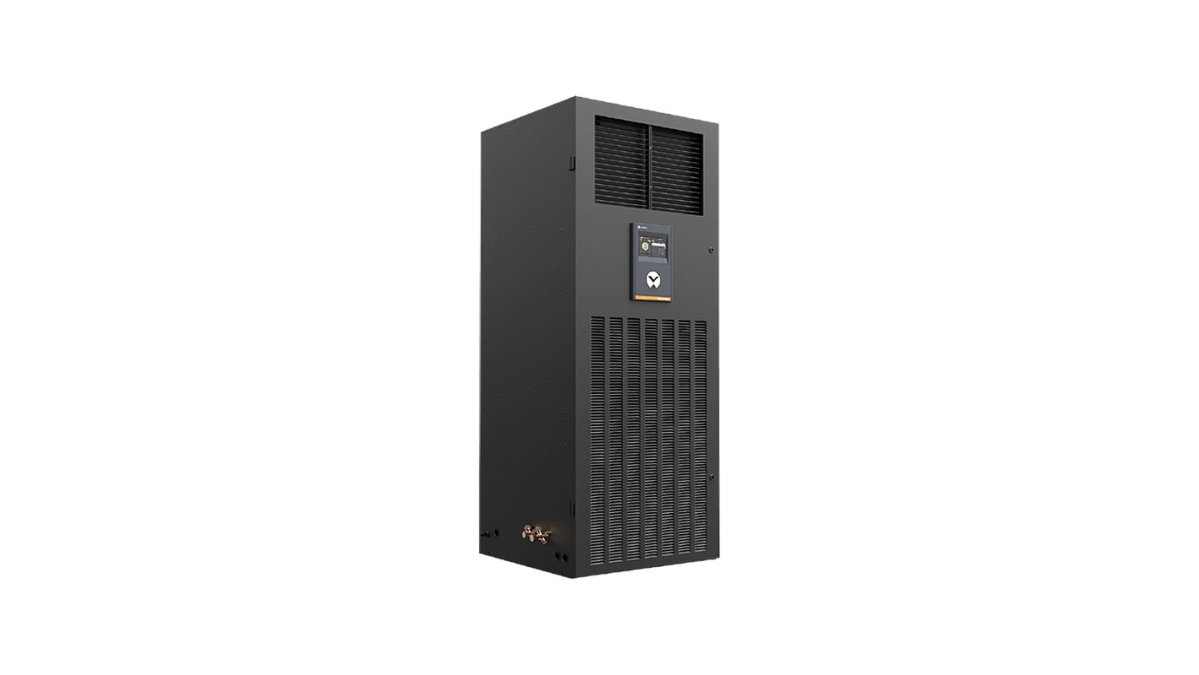
2. Vertiv Liebert DM 22-27kW: Best for Small to Medium Computer Rooms
The Vertiv Liebert DM in the 22-27kW range suits small to medium computer rooms, network rooms, and UPS or battery rooms needing year-round precision cooling in a compact footprint.
3. Stulz Minispace 6-32kW: Best for Retrofitting Existing Server Rooms
The Stulz MiniSpace EC series is the practical choice for retrofitting existing server rooms because its compact size fits spaces never designed for precision cooling.

4. Rittal All-in-One Micro Data Center: Best Liquid-Cooled Edge Unit
The Rittal all-in-one micro data center is the pick for edge deployments needing a self-contained, liquid-cooled unit that does not heat the room around it.
5. Vertiv SmartRow and SmartCabinet: Best All-in-One Contained Solutions
The Vertiv SmartRow and SmartCabinet families are the best all-in-one contained solutions, bundling enclosure, power, cooling, and monitoring into one integrated system.
6. APC NetShelter Aisle Containment: Best Airflow Upgrade for Legacy Halls
APC by Schneider Electric NetShelter Aisle Containment is the best airflow upgrade for legacy halls because it fixes the root cause of most cooling waste: hot and cold air mixing.
The mechanism, in plain terms
The system encloses the hot aisle with roof panels and end doors, creating a separate exhaust pathway back to the CRAC or CRAH return. That stops hot air recirculating into the cold aisle, delivering a higher return air temperature at the coil, a larger delta-T across the cooling unit, and more usable capacity from the plant you already own.
Retrofitting into a live hall
Containment can almost always be installed without an outage, but the sequence matters:
- Survey and CFD-lite assessment. Map cold-aisle temperatures at the top, middle, and bottom of each rack to identify the worst mixing zones. A grid of temperature sensors and a floor plan is enough to prioritise, no full CFD model needed for a single hall.
- Fix the basics first. Blanking panels, brush strips, and rear cable management close leaks containment cannot fix. Skip this and you pay for containment and still leak air.
- Stage the install by aisle. Containment is modular: install one aisle, run it for a week, measure the delta-T improvement, then move to the next. This keeps the hall live and lets you stop if results do not justify the spend.
- Review fire detection zoning. AS 1670.1 requires detection coverage appropriate to the space, and sealing a hot aisle changes smoke travel. The fire engineer must confirm existing detection and suppression still perform as designed, sometimes adding aspirating smoke detection inside the contained aisle.
- Check egress and WHS. End doors must open freely and not obstruct escape routes. State WHS regulations and AS 1657 (fixed platforms, walkways, ladders) apply if containment includes overhead structures needing access.
- Re-commission the cooling plant. Containment changes the return air conditions CRAC units see, so controls tuned for a mixed-air hall need re-tuning and the site acceptance test should be repeated under real load.
What containment does not fix
Containment alone will not fix an undersized cooling system, if your thermal load already exceeds capacity, it buys time but not a solution. It also does not address rack densities above roughly 15-20 kW, where air cannot carry the heat away regardless of how well the aisle is sealed. At that point you need in-row, direct-to-chip, or immersion, and containment becomes the supporting layer rather than the answer.
Vertiv Liebert CRV4 — In-Row Precision →
The measurement discipline
Before: log cold-aisle intake temperatures at the top of every rack for at least a week, including a peak-load day. Record cooling plant power draw at the same time.
Choosing the Right Cooling Infrastructure
Match the system to the unit of cooling you actually control. Room, row, or rack: pick the wrong level and no amount of capacity fixes the problem. The decision is also about the efficiency, compliance, and operating-cost envelope you are signing up for over the next decade.
Start with the efficiency numbers, not the brochure
Power Usage Effectiveness (PUE) is the ratio of total facility power to IT power. A legacy air-cooled hall with mixing airflow commonly sits between 1.8 and 2.2; well-designed containment and in-row cooling pull that toward 1.3-1.5. Direct-to-chip and immersion can push below 1.2, but only when the heat rejection loop is sized correctly, a liquid loop bolted onto an undersized chiller simply moves the inefficiency outdoors.
Compliance and safety are part of the selection
Cooling infrastructure in Australia sits inside a web of obligations a product datasheet will not mention:
- Electrical safety, installations must comply with AS/NZS 3000 (Wiring Rules) and, for the IT load, AS/NZS 3010. Switchboard and PDU design follows AS/NZS 61439.
- Fire safety, AS 1670.1 governs fire detection and alarm, AS 2118 covers sprinklers. Aisle containment changes smoke behaviour, so detection zoning usually needs review when containment is added.
- Refrigerants, synthetic refrigerants are controlled under the Ozone Protection and Synthetic Greenhouse Gas Management Act 1989 and associated regulations. Higher-GWP refrigerants attract a levy, and technicians handling them need an ARCtick licence, a real OPEX line, not a footnote.
- Coolants in liquid systems, single-phase and two-phase fluids must be assessed for material compatibility, toxicity, and flammability. Dangerous goods classifications trigger storage and spill containment obligations under state WHS laws and the Australian Dangerous Goods Code.
- Energy reporting, facilities above the thresholds in the National Greenhouse and Energy Reporting Act 2007 must report energy consumption, making PUE and WUE measurement a compliance task, not just an engineering one.
The retrofit decision tree
For a legacy hall with mixing airflow, start with containment and airflow management, the lowest-disruption efficiency gain available, working alongside almost any existing cooling plant. Measure the result before adding capacity.
The two factors that decide most projects
First, retrofit disruption: can the work happen without an outage? A unit that fits through an existing doorway and connects to existing services keeps the room running; one needing a new slab, switchboard capacity, or crane lift does not.
The best data centre cooling solution is the one matched to your actual rack density, your climate, your compliance obligations, and your retrofit constraints, not the one with the highest headline capacity or the lowest purchase price.
Frequently Asked Questions
What is the best cooling system for a data center?
There is no single best system. For high-density racks above 8 kW, in-row precision cooling such as the Vertiv Liebert CRV4 captures heat at the source and scales from roughly 12 kW to 66 kW. For small to medium computer rooms, the Vertiv Liebert DM at 22-27 kW or the Stulz Minispace at 6-32 kW suit most footprints. Edge sites with limited floor space often run better on a liquid-cooled micro data centre like the Rittal all-in-one unit at 3 kW or 6.5 kW.
How does liquid cooling vs air cooling efficiency compare in 2026?
Liquid cooling removes heat more directly than air because the coolant sits closer to the chip, so it handles higher thermal loads per rack. Air cooling still suits lower-density rooms and remains cheaper to install and maintain. The practical split is density: below roughly 8 kW per rack, air cooling with good containment is usually enough. Above that, liquid or direct-to-chip approaches start to pay back through lower fan energy and reduced hot spots.
How do Australian energy standards influence cooling system selection?
Australian operators track power usage effectiveness (PUE) and water usage effectiveness (WUE) closely, and reporting obligations under the National Greenhouse and Energy Reporting scheme push sites to document consumption. That favours cooling with variable-capacity compressors, EC fans and free-cooling modes, because these cut energy draw at part load. Selecting equipment with Modbus or SNMP monitoring also makes compliance reporting simpler, since you can pull live data instead of estimating.
What role does AI play in optimising data centre cooling performance?
AI-driven thermal management systems read temperature, humidity and load data across the hall and adjust fan speeds, compressor output and chilled water flow in real time. The gain comes from part-load operation: instead of running cooling at a fixed setpoint, the system trims output as demand drops. Combined with aisle containment, this reduces hot spots and cuts energy use without sacrificing the temperature and humidity tolerance your equipment needs.
What are the key factors for selecting a data centre cooling provider?
Look for design capability, not just equipment supply. Ask how they handle commissioning and site acceptance testing, what preventative maintenance looks like after handover, and whether they work across multiple sites. An agnostic provider can match the cooling type to your load profile rather than pushing one brand. Confirm they can service legacy equipment alongside new units, and check references from similar facilities such as hospitals or edge deployments.