

Last Updated: October 29, 2026
Quick Summary
The lithium ion vs lead acid UPS choice is a trade-off between higher upfront cost for a lighter, longer-lived battery and a lower purchase price with more frequent replacements. Lead-acid usually wins on capital cost, but once replacements, cooling and floor space enter a total cost of ownership model, the lithium premium can narrow considerably.
- 54% of respondents now use lithium batteries for centralised UPS energy storage, while 36% still use lead-acid.
- A 15-year period with a 5-year lead-acid life means three banks; a 12-year lithium life means one.
- Lead-acid is usually limited to around 50% depth of discharge to protect cycle life; lithium tolerates deeper discharge.
- Lithium systems depend on a battery management system to monitor cells, balance them and isolate faults.
- Skip lead-acid if you plan a 10-year service life, your battery room is hot, or floor space is constrained.
Table of Contents
- Lithium Ion vs Lead Acid UPS: The Core Trade-Off
- Upfront Cost and the UPS Battery Total Cost of Ownership
- Data Centre UPS Battery Lifespan and Replacement Cycles
- Energy Density, Weight and UPS Battery Room Space Requirements
- Data Centre UPS Battery Sizing for Real Load Profiles
- Safety, Standards and Failure Modes Compared
- Choosing Your UPS Battery Chemistry With an Agnostic Partner
- Frequently Asked Questions
Lithium Ion vs Lead Acid UPS: The Core Trade-Off
The lithium ion vs lead acid UPS decision comes down to one trade-off: pay more upfront for a lighter, longer-lived battery, or pay less now and replace it more often. According to the ZincFive 2026 Data Center Energy Storage Industry Insights Report, 54% of respondents now use lithium batteries for centralised UPS energy storage, while 36% still use lead-acid.
That shift is real, but it isn't universal. At Treske, we specify both chemistries because the right answer depends on your load profile, your floor space and how long you plan to keep the UPS in service. For the wider picture these factors feed into, see our data center power system efficiency metrics guide.
A UPS battery is the energy store that carries a critical load between mains failure and generator start, or through a full outage. Understanding these fundamental battery chemistry comparisons provides a clearer perspective on how energy storage requirements shift across different industrial applications, including those explored in our analysis of lithium battery vs lead acid golf cart performance.
Upfront Cost and the UPS Battery Total Cost of Ownership
Lead-acid generally wins on capital cost, but a capital-cost comparison is not a total cost of ownership comparison, and most published comparisons stop there. But a capital-cost comparison is not a total cost of ownership comparison, and most published comparisons stop there.
A UPS battery total cost of ownership has six cost lines, and each behaves differently by chemistry:
- Purchase price of the battery bank, normalised to usable kWh at your required runtime
- Replacement cycles over the UPS service life
- Maintenance labour, impedance testing and capacity testing
Building a Like-for-Like Lifecycle Cost Model
Most comparisons fail because they compare a lead-acid price against a lithium price without normalising for service life, usable capacity or cooling load. Use this model instead, and write your assumptions down so the result is auditable:
- Set the evaluation period. Use the expected UPS service life (commonly 10 or 15 years) rather than the battery warranty.
- Normalise capacity. Convert both options to usable kWh at your target runtime, accounting for depth of discharge and end-of-life capacity fade. A nameplate kWh is not a usable kWh.
- Count replacements. Divide the evaluation period by each chemistry's expected service life in your ambient temperature, then round up. A 15-year period with a 5-year lead-acid life means three banks; a 12-year lithium life means one bank plus a partial-life credit.
- Price each replacement at today's price and state whether you have escalated it. If you escalate, use one stated rate for both chemistries so the comparison stays fair.
- Add annual maintenance per chemistry: labour hours, test equipment, and any contracted service. Lead-acid typically needs more frequent inspection and testing than a lithium system with an integrated battery management system.
- Add cooling energy. Estimate the heat rejected by each battery type and multiply by your cooling cost per kWh and your annual operating hours. Lead-acid's sensitivity to temperature usually forces tighter room cooling, which is a real operating cost.
- Add floor space at your facility's rate per square metre per year, multiplied by the footprint difference between the two options.
- Add end-of-life cost for disposal, recycling and transport, and subtract any residual warranty or salvage value at the end of the period.
Worked example. Over a 15-year period, a lead-acid bank with a 5-year life implies three replacements, while a lithium bank with a 12-year life implies one. Once replacements, cooling and floor space enter the model, the upfront premium can narrow considerably. In well-cooled rooms with cheap floor space and a short holding period, lead-acid can still win on total cost.
What the Model Usually Reveals
Three patterns recur when the assumptions are made explicit:
- Holding period dominates. The shorter your intended service life, the stronger the lead-acid case. The longer the period, the more the replacement count favours lithium.
- Cooling and floor space are the swing factors. In hot rooms or expensive floor space, these two lines can outweigh the purchase-price gap on their own.
- Maintenance labour is easy to underestimate. Frequent inspection and testing is a recurring cost that compounds over the evaluation period, and it is often omitted from headline comparisons.
Xf Series Lead Acid Battery gives you a concrete reference point if you are pricing a lead-acid replacement programme, and the same model can be run against a lithium option for a like-for-like result.
Data Centre UPS Battery Lifespan and Replacement Cycles
Data centre UPS battery lifespan is the number that reshapes the whole business case.
Heat is the silent killer of lead-acid. If you are pricing a lead-acid replacement programme, the Xf Series lead acid battery gives you a concrete reference point.
Xf Series Lead Acid Battery gives you a concrete reference point if you are pricing a lead-acid replacement programme.
Watch out: a lead-acid bank that "still passes" a capacity test at year four can fail a real load transfer at year five. Test to your actual load, not a nominal one.
Energy Density, Weight and UPS Battery Room Space Requirements
UPS battery room space requirements are where lithium-ion pulls clearly ahead. Lithium batteries are generally smaller and lighter, with higher power and energy density than lead-acid.
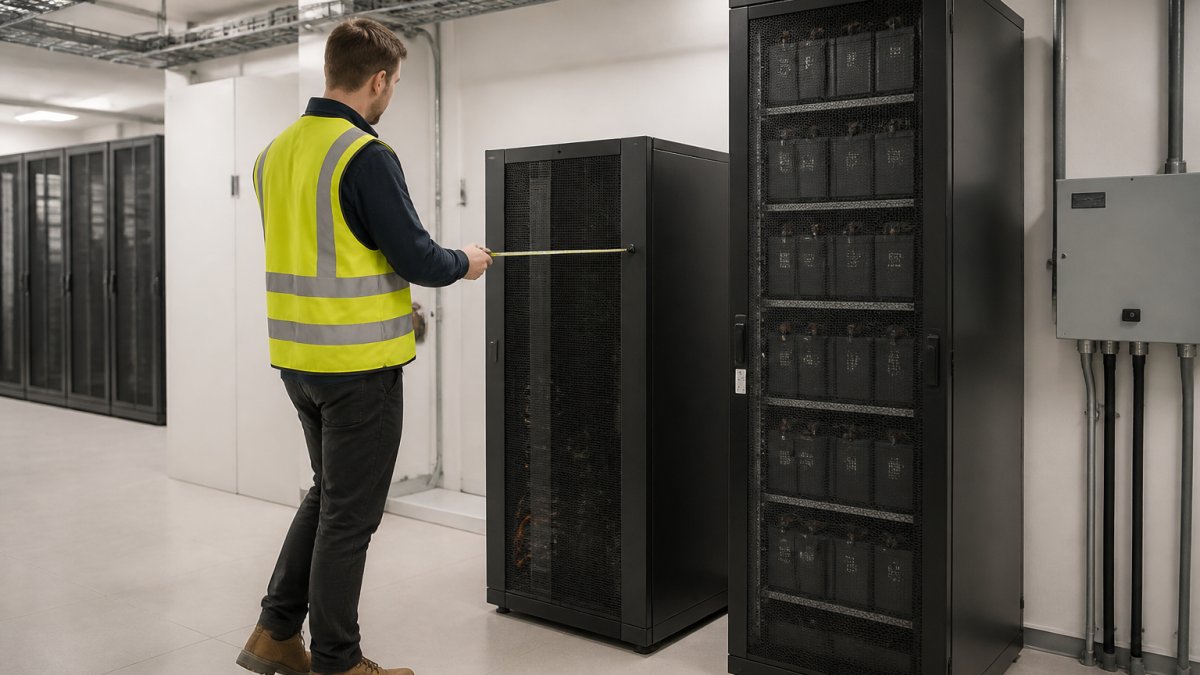
Why that matters in practice:
- Floor loading. Lead-acid banks are heavy. Older buildings often need structural review before installation.
- Rack space. Lithium systems pack more usable capacity per rack unit.
- Retrofit headroom. Compact lithium cabinets free space for IT equipment instead of batteries.
If footprint is your binding constraint, Eaton Extended Battery Cabinet 48VDC for Eaton 9PX Lithium Ion UPS 1U Rack shows how external lithium modules add runtime without expanding the battery room.
Data Centre UPS Battery Sizing for Real Load Profiles
Data centre UPS battery sizing should follow your measured load profile, not the nameplate rating. Size to the actual kilowatt draw at your target runtime, then add margin for growth.
Eaton 9PX Lithium Ion Series UPS 1500VA - 3000VA R/T →
A battery sized for 100% load and one sized for a realistic 60% average load behave very differently. Real data centre loads fluctuate, and the battery must carry the peak, not the average.
Depth of Discharge, Discharge Rate and Usable Capacity
Usable capacity is not nameplate capacity. Depth of discharge limits how much you can safely draw, and discharge rate affects how much you actually get.
- Depth of discharge (DoD): lead-acid is usually limited to around 50% DoD to protect cycle life; lithium tolerates deeper discharge.
- Discharge rate: a faster draw delivers less total energy from lead-acid than from lithium.
- Recharge time: lithium recharges faster, which matters when you face multiple outages in a day.
Runtime is a sizing outcome, not a chemistry guarantee.
Safety, Standards and Failure Modes Compared
Thermal runaway is possible with any battery chemistry, and lithium-ion has a shorter operating track record in data centres than vented lead-acid or VRLA (Lithium Ion Batteries for the data center. Are they ready for production yet?). That is the honest position from the Uptime Institute Journal on lithium-ion batteries in the data centre, and it should shape your risk assessment.
Failure Modes Side by Side
| Failure mode | Lead-acid (VRLA / vented) | Lithium-ion |
|---|---|---|
| Thermal event | Rare, but can occur through overcharge, internal short or dry-out | Possible through overcharge, internal short, mechanical damage or manufacturing defect; can propagate between cells |
| Gas release | Vents hydrogen under fault or overcharge; requires ventilation and, for vented types, spill containment | Vents flammable and toxic gases during a thermal event; requires ventilation and gas detection |
| Electrical fault | Short-circuit current is high; needs correct fusing and isolation | Short-circuit current is high; needs correct fusing, contactor isolation and cell-level monitoring |
| Ageing failure | Capacity fade and increased internal resistance; can pass a nominal test and still fail a real transfer | Capacity fade managed by the battery management system; cell imbalance is monitored |
| Detection | Room temperature, gas detection and periodic testing | Cell voltage, cell temperature, gas detection and system-level alarms |
Controls That Actually Differ
The engineering controls are where the two chemistries diverge, and they should drive your specification:
- Battery management system (BMS). A lithium system depends on a BMS to monitor cell voltage and temperature, balance cells, and isolate faults. Specify what the BMS does on fault: does it open the contactor, alarm only, or trip the UPS? Lead-acid has no equivalent cell-level electronics, so protection relies on charger design, fusing and periodic testing.
- Ventilation. Lead-acid needs ventilation sized for hydrogen release under fault and normal gassing. Lithium needs ventilation and gas detection designed around the specific chemistry's vent-gas profile.
- Fire detection and suppression. Specify detection that responds to the failure mode you are protecting against, and confirm the suppression agent is suitable for the chemistry and the enclosure. Do not assume a legacy clean-agent design covers a lithium cabinet.
Standards, Codes and Permitting
Battery installation in a data centre is governed by a stack of electrical, fire and building requirements, and the applicable edition varies by jurisdiction. At a minimum, your specification should reference:
- Electrical installation requirements for the battery system, including protection, earthing and isolation.
- Fire safety requirements for the battery room or cabinet, including detection, suppression and separation from occupied spaces.
- Battery installation and ventilation requirements for the specific chemistry, including hydrogen ventilation for lead-acid and gas detection for lithium.
Confirm the current edition of each requirement with your local authority and your insurer before you commit to a chemistry. Permitting timelines can differ between chemistries because the fire-safety case differs, and that can affect project schedule as much as cost.
Failure modes drive your redundancy design. If a single battery string is a single point of failure, Data Center Power Redundancy Solutions in 2026 covers the architectures that remove it.
Choosing Your UPS Battery Chemistry With an Agnostic Partner
We stay agnostic on chemistry because the answer changes per site. Once you have chosen, our UPS battery maintenance and replacement service supports the batteries you select.
Best for lead-acid: short-horizon deployments, tight capital budgets, well-cooled rooms with space to spare.
Skip lead-acid if: you are planning a 10-year service life, your battery room is hot, or floor space is already constrained.
Best for lithium-ion: long service life, space-constrained rooms, remote sites with limited maintenance visits.
Skip lithium-ion if: upfront capital is the hard constraint or your risk assessment cannot support the fire protection requirements.
When you are ready to act on the decision, UPS battery maintenance and replacement covers the ongoing service side, and our team can scope the specification against your actual load profile. Whichever chemistry you land on, UPS Installation and Preventative Maintenance carry the decision through to a working, tested system.
Frequently Asked Questions
Are lithium-ion batteries better than lead-acid batteries for data centre UPS systems?
Neither wins on every measure. Lithium-ion is increasingly used for centralised UPS energy storage, alongside lead-acid. Lithium-ion gives longer stated life, up to 10 years or more versus 3-6 years for lead-acid, and a smaller footprint. Lead-acid costs less upfront and has a longer track record in data centres. The right choice depends on your runtime targets, replacement cycles and available floor space, not on chemistry alone.
How long do lithium-ion UPS batteries last compared with lead-acid batteries?
Stated figures vary by vendor. Stated service life varies by vendor, and lead-acid is generally shorter-lived than lithium-ion. Heat is the main variable: lithium-ion tolerates higher operating temperatures better, while VRLA capacity fades faster in a warm battery room. Treat these as vendor claims and check the warranty terms on the specific model you shortlist.
Which UPS battery takes up less space in a data centre?
Lithium-ion. Lithium-ion batteries are generally smaller and lighter with higher power and energy density than lead-acid. That matters when battery room space requirements are tight or you are retrofitting an existing room. A 1U external lithium pack, such as the APC Smart-UPS Ultra Lithium-Ion Battery Pack 1U, adds runtime without a new cabinet, whereas lead-acid banks need more cabinets and floor loading allowance.
How should a data centre compare the total cost of ownership of UPS batteries?
Build the model over the life of the facility, not the first invoice. Count capital cost, the number of battery replacements across the period, maintenance and monitoring labour, cooling load, and floor space. Lithium-ion costs more upfront but needs fewer replacements; lead-acid is cheaper to buy but is replaced more often. Compare UPS battery total cost of ownership at the same runtime and load, and keep the assumptions visible so finance can audit them.
The hard part isn't picking a chemistry. It's proving the choice holds up over 15 years of load growth, tariff changes and replacement cycles. Treske designs, supplies and installs power, cooling and rack systems with an agnostic approach, backed by professional maintenance, commissioning and optimisation services. Get started with Treske and specify a UPS battery system built around your real load profile.
