


Table of Contents
- Resilience and Performance Are Not Opposing Forces
- Data Centre Capacity Planning for Predictable Growth
- Data Centre Redundancy Best Practices That Support Uptime
- Data Centre Power and Cooling Design for Critical Facilities
- Data Centre Scalability and Flexibility Without Compromise
- The Resilience-Performance Trade-Off Under Cost and Energy Constraints
- Conclusion: Building Infrastructure That Delivers Both
- Frequently Asked Questions
Last Updated: October 9, 2026
Resilience and Performance Are Not Opposing Forces
Enhanced critical infrastructure resilience and optimised data centre performance are not competing goals; data centre resilience and performance are two outputs of the same design discipline. When we treat them as a trade-off, we end up with infrastructure that is either over-built and under-utilised, or fast and fragile. At Treske Pty Limited, we design, supply and install power, cooling and rack systems across Australia and New Zealand, and the projects that age best are the ones where resilience targets were written down before a single rack was specified. This guide covers capacity planning, redundancy, power and cooling design, scalability, and the cost and energy trade-offs that decide whether your data centre resilience holds up under real load.
The core argument is simple: resilience is a design input, not a contingency you bolt on after commissioning. Teams that treat it as an afterthought pay for it twice, once in capital and again in every unplanned event.
Data Centre Capacity Planning for Predictable Growth
Data centre capacity planning is the practice of matching available power, cooling, space and network capacity to forecast demand before that demand arrives. Predictable growth comes from measuring actual consumption, not from guessing at headroom. A common mistake is planning to nameplate ratings rather than to real, metered load, which hides the true constraint until it becomes an outage risk.
Start with three inputs: current measured load, a realistic growth rate, and the physical limits of the room. Then design to the tightest of the three.
Setting Quantitative Design Metrics and Service-Level Targets
Quantitative design metrics turn vague ambitions into numbers a contractor can build to. Define availability targets, acceptable downtime per year, redundancy level (N+1, 2N), and recovery time objectives before design begins. Service-level targets should be specific: a target of "high availability" means nothing, while "concurrent maintainability with no load interruption" is testable. Document these targets, then verify them at commissioning through site acceptance testing.
| Design Metric | What It Defines | Typical Target |
|---|---|---|
| Availability | Uptime commitment | Concurrently maintainable |
| Redundancy | Spare capacity path | N+1 or 2N |
| Recovery time objective | Time to restore service | Agreed per system |
| Recovery point objective | Acceptable data loss | Agreed per workload |
| Power usage effectiveness | Energy efficiency | Tracked and reported |
Data Centre Redundancy Best Practices That Support Uptime
Data centre redundancy best practices begin with identifying single points of failure, then deciding which ones justify the cost of duplication. Redundancy is not the same as resilience: duplicated equipment that shares one feed, one switchboard or one cooling path is still a single point of failure. Map every dependency, from utility supply through to the rack PDU, and test each path under load.
A practical way to structure this is to assign each system a redundancy level and a recovery objective before design begins. The table below shows how those two decisions interact.
| System | Redundancy Level | Recovery Time Objective | Recovery Point Objective |
|---|---|---|---|
| Utility intake | N+1 or 2N | Seconds to minutes (UPS ride-through) | Not applicable |
| UPS | N+1 or 2N | Zero interruption on transfer | Not applicable |
| Cooling | N+1 | Minutes before thermal alarm | Not applicable |
| Network path | Diverse entries | Seconds (automatic failover) | Not applicable |
| Data storage | RAID or replicated | Minutes to hours | Agreed per workload |
For power, online double conversion UPS systems such as the Vertiv Liebert EXS series provide continuous, conditioned power with fault-tolerant architecture. For distribution, metered and switched rack PDUs let you sequence startup and shed non-critical load during recovery, which protects the critical path when it matters most.
Threat Modelling and Disaster Recovery Planning
Threat modelling identifies what could take your infrastructure down, then ranks each threat by likelihood and impact. Work through utility failure, cooling loss, fire, water ingress, cyber intrusion and human error. Disaster recovery planning then defines the response: what fails over, how fast, and who decides. Business continuity depends on testing these plans, not just writing them.
A common pattern is to run a tabletop exercise every six months and a live failover test annually. The tabletop surfaces decision-making gaps; the live test surfaces sequencing faults, overloaded circuits and stale configuration. Both are needed, and neither replaces the other.
For critical facilities, align recovery objectives with the consequences of downtime. A hospital or utility control room may justify a recovery time objective measured in seconds, while a development environment may tolerate hours. The objective should drive the redundancy level, not the other way around.
Data Centre Power and Cooling Design for Critical Facilities
Data centre power and cooling design determines how much resilience you can actually deliver per rack. Power design covers utility intake, UPS topology, distribution and metering. Cooling design covers heat rejection, airflow management and containment. Get the airflow wrong and you pay for cooling capacity you never effectively use.
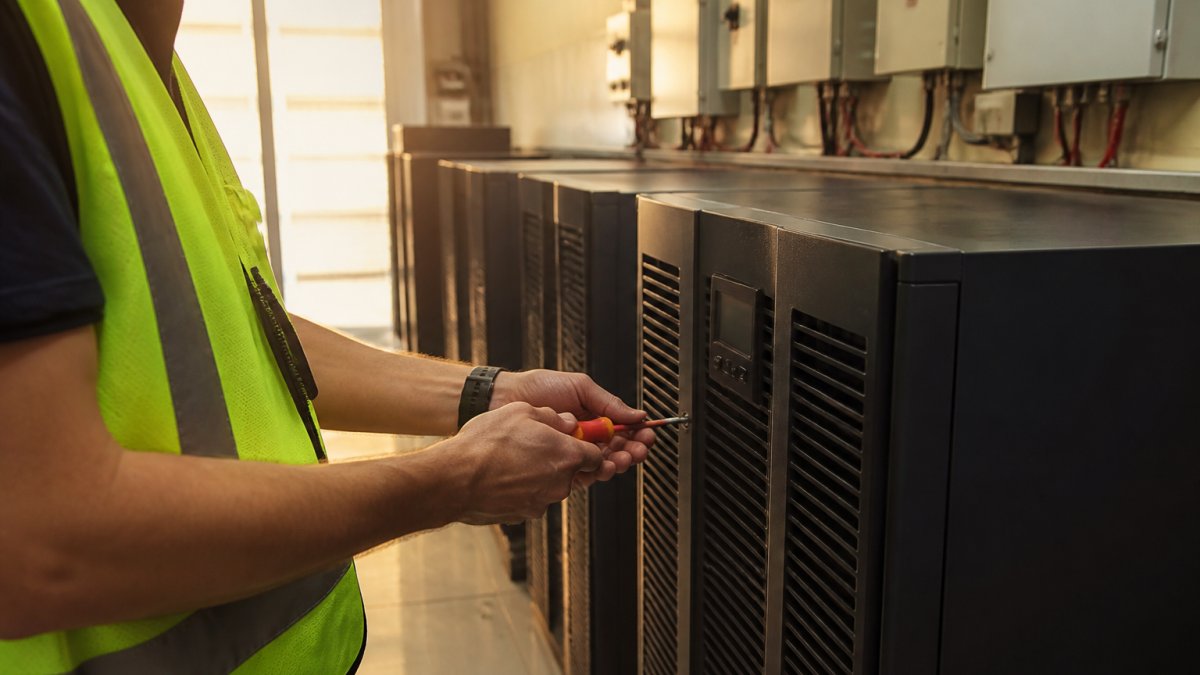
Precision cooling units such as the Vertiv Liebert DM range maintain temperature and humidity within tight tolerances for small to medium computer rooms. Airflow management matters just as much: blanking panels in unused rack units prevent hot air recirculation and improve cooling efficiency at minimal cost. For visibility, monitoring interfaces like the Vertiv RDU-SIC G2 integrate UPS and cooling assets into centralised DCIM, NMS or BMS environments, so alarms reach the right people before a fault becomes an outage.
Ekkosense Datacenter Optimization →

Data Centre Scalability and Flexibility Without Compromise
Data centre scalability and flexibility mean adding capacity in modular increments without rebuilding the whole facility. Modular design lets you expand power, cooling and rack space in step with demand, which protects capital and keeps efficiency high. The compromise most teams make is oversizing upfront, which locks in low efficiency for years.
A more disciplined approach is to model remaining capacity across power, cooling, space and network before each increment. Track four numbers: available power (kW), available cooling (kW), usable rack units (U) and switch port headroom. The lowest of those four is your true constraint, and it is rarely the one teams assume.
Phased Implementation and Lifecycle Governance
Scalability is not only a design decision; it is an operational discipline. A phased implementation plan typically moves through four stages: design and commissioning, steady-state operation, incremental expansion, and periodic review. Each stage has its own governance needs.
- Design and commissioning: verify that as-built capacity matches design intent through site acceptance testing.
- Steady-state operation: monitor power usage effectiveness, rack inlet temperatures and UPS load percentage continuously.
- Incremental expansion: add capacity in matched modules so redundancy levels stay consistent across the estate.
- Periodic review: reassess growth forecasts, decommission end-of-life equipment, and update recovery objectives.
An agnostic approach to technology helps here. Rather than committing to a single vendor's stack, select power, cooling and enclosure systems on their merits for each increment. DCIM and optimisation software such as Ekkosense, Sunbird or EcoStruxure IT can model remaining capacity across mixed legacy and new equipment, so you expand on evidence rather than assumption.

Where resilience and scalability meet, the modular approach has an advantage: it lets you add redundancy in the same increment as capacity, rather than retrofitting it later at higher cost and disruption. That is the practical answer to the trade-off the keyword frames, not choosing between resilience and performance, but sequencing both through the same expansion plan.
The Resilience-Performance Trade-Off Under Cost and Energy Constraints
The resilience-performance trade-off is real, but it is narrower than most budgets assume. Higher redundancy costs capital and can reduce efficiency, because duplicated equipment often runs at part load. The way out is to target redundancy where failure is genuinely unacceptable and to accept measured risk elsewhere.
Energy efficiency and resilience can align: efficient UPS modes, containment and blanking panels reduce waste without removing redundancy. Where they conflict, quantify the cost of downtime against the cost of the redundancy that prevents it, then decide deliberately. For critical facilities, that calculation usually favours resilience.
| Approach | Resilience Impact | Efficiency Impact | Best For |
|---|---|---|---|
| N+1 redundancy | Protects against single failure | Moderate part-load loss | Most commercial facilities |
| 2N redundancy | Protects against full path failure | Higher capital and energy cost | Hospitals, critical utilities |
| Modular expansion | Maintains designed redundancy | Keeps efficiency high | Growing multi-site estates |
| Containment and blanking | Reduces hot spots | Improves cooling efficiency | All rack environments |
Conclusion: Building Infrastructure That Delivers Both
The challenge is not choosing between resilience and performance; it is designing both into the same facility from the first specification. That requires agreed service-level targets, honest capacity data, tested recovery plans and modular expansion. Treske Pty Limited provides design, supply and installation of power, cooling and rack enclosure systems, backed by commissioning, site acceptance testing and preventative maintenance. Visit us today to build infrastructure that delivers both.
Frequently Asked Questions
What is the difference between infrastructure resilience and data centre performance?
Resilience is the ability to withstand and recover from disruptive events such as power outages, equipment failures, or thermal incidents. Performance refers to how efficiently the facility handles compute workloads, including processing speed, throughput, and energy efficiency. Resilience focuses on uptime and fault tolerance, while performance focuses on output and resource utilisation. A well-designed facility treats both as complementary objectives, using redundancy and monitoring to protect the performance gains achieved through optimised cooling and power delivery.
How do you design data centre infrastructure to scale?
Scalable infrastructure design starts with modular components that can be added incrementally as demand grows. This means specifying power and cooling systems with headroom, using rack enclosures that accommodate future density, and deploying DCIM software for real-time capacity planning. Monitoring tools such as Ekkosense and Sunbird provide visibility into available space, power, and cooling resources, so you can plan expansions without over-provisioning. A phased approach to deployment reduces upfront capital expenditure while maintaining the ability to scale quickly when needed.
How can data centre performance be optimised without compromising resilience?
Performance optimisation and resilience can coexist when you use real-time monitoring to identify inefficiencies without removing redundancy. For example, Ekkosense software uses AI-driven analytics to optimise cooling capacity and remove thermal risk, which improves efficiency while maintaining fault tolerance. Similarly, UPS systems with ECO mode, such as the Vertiv Liebert EXS, deliver energy savings without bypassing double-conversion protection. The key is to optimise within the boundaries of your redundancy architecture, not by eliminating it.
What should a scalable data centre infrastructure plan include?
A scalable plan should cover capacity planning for power, cooling, and space; redundancy levels aligned with uptime targets; modular power and cooling systems; and monitoring tools that provide real-time visibility. It should also address lifecycle governance, including commissioning, site acceptance testing, and preventative maintenance. Documenting service-level targets and quantitative design metrics ensures that every expansion decision is measured against clear performance and resilience objectives.
How do redundancy and capacity planning affect data centre resilience?
Redundancy provides backup capacity when a component fails, while capacity planning ensures you have enough resources to meet current and future demand. Together, they determine how well your facility handles disruptive events. Without accurate capacity planning, redundancy can be compromised by overloaded systems. Without redundancy, capacity planning cannot protect against unexpected failures. Using DCIM tools like Sunbird for asset and capacity management helps you track both, so you can maintain resilience as your facility grows.