

Table of Contents
- Why Cooling Systems Efficiency Determines Your Operating Costs
- Optimising Airflow in Data Centres
- Inverter Technology, Economisers and Equipment Upgrades
- Is Modular Cooling Good for Small Server Rooms?
- HVAC Preventative Maintenance Checklist
- Smart Monitoring, Zoning and ROI of Cooling System Upgrades
- Passive Cooling, Insulation and Building Envelope Improvements
- Improving Energy Efficiency in Cooling Systems: Where to Start
- Frequently Asked Questions
Last Updated: September 2, 2026
Why Cooling Systems Efficiency Determines Your Operating Costs
Cooling infrastructure is one of the largest single consumers of energy in any data centre or critical facility, often accounting for roughly half of total site energy consumption. Improving energy efficiency in cooling systems is a direct line to operational cost reduction. The core problem is straightforward: most cooling systems are sized for peak load, then run continuously at that capacity regardless of actual thermal demand, resulting in significant energy waste during off-peak hours and lower IT utilisation periods.
The Australian Government's Department of Climate Change, Energy, the Environment and Water guidance on data centre energy identifies cooling optimisation as the highest-impact intervention available to facility operators. Below, we cover the specific interventions that move the needle: airflow containment, inverter technology, economiser integration, maintenance discipline, smart monitoring, and passive building improvements.
Optimising Airflow in Data Centres
Poor airflow management is the most common cause of inefficient cooling in server environments. Hot exhaust air recirculates back into equipment intakes, forcing cooling units to work harder to maintain safe inlet temperatures.
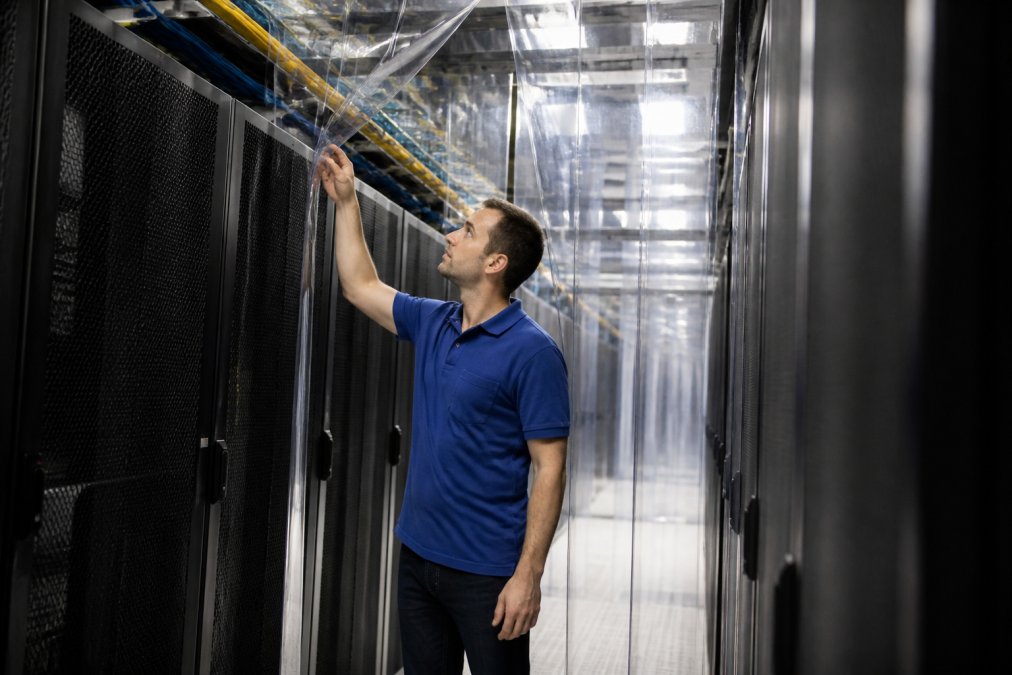
Hot Aisle and Cold Aisle Containment
Hot aisle/cold aisle containment physically separates exhaust air from server racks (hot aisle) from cool supply air (cold aisle) using curtains, doors, or ceiling panels. This prevents mixing, allowing cooling units to raise their supply air temperature without risking equipment overheating. Raising the supply temperature set point even a few degrees meaningfully reduces compressor energy consumption. The ASHRAE TC 9.9 thermal guidelines for data processing environments provide the reference envelope for safe inlet temperatures, which most modern equipment tolerates at the higher end of the recommended range.
Blanking Panels and Raised Floor Management
Blanking panels seal empty rack unit spaces to prevent hot air short-circuiting back through the rack. For facilities with raised floor plenums, perforated tiles should be positioned directly in front of equipment intakes, not in aisles where airflow is wasted. Grommets and cable cut-outs should be sealed to prevent uncontrolled leakage. These tasks can be completed by your team without specialist contractors.
Inverter Technology, Economisers and Equipment Upgrades
The biggest gains in improving energy efficiency in cooling systems at the equipment level come from inverter-driven compressors and economiser modes, both addressing the fundamental inefficiency of running fixed-capacity equipment against variable loads.
Inverter-Driven Compressors vs Fixed-Speed Units
Inverter technology allows a compressor to modulate its speed in response to actual cooling demand rather than cycling on and off at full power. Fixed-speed compressors operate at 100% capacity or not at all; inverter-driven units can run at 30%, 60%, or 80% depending on load requirements. The energy saving at partial load is significant, particularly in environments where IT load fluctuates across the day or week.
Precision cooling products such as the Vertiv Liebert SRC-G incorporate advanced airflow management and variable capacity control suited to small and medium data centre environments. When evaluating a replacement or upgrade, compare the energy efficiency ratio at partial load conditions, not just at peak.

Economiser Modes and Free Cooling Integration
Economiser integration allows cooling systems to use ambient temperature conditions to reduce or eliminate mechanical refrigeration. When outdoor ambient temperature drops below a threshold, an economiser circuit can pre-cool return air or supply chilled water without running the compressor. The economic case depends on climate; facilities in cooler regions get more annual hours of free cooling than those in tropical or subtropical zones.
Is Modular Cooling Good for Small Server Rooms?
Modular cooling is well-suited to small server rooms. A modular approach deploys multiple smaller cooling units rather than one large centralised system, providing redundancy: if one module fails, the others continue operating. Modular units can be added as IT load grows, meaning each unit operates closer to its design capacity for longer, directly supporting improving energy efficiency in cooling systems over the facility's lifecycle.
The limitation is per-unit cost. For very small rooms with stable, predictable loads and no redundancy requirement, a single well-matched unit may be more cost-effective.
HVAC Preventative Maintenance Checklist
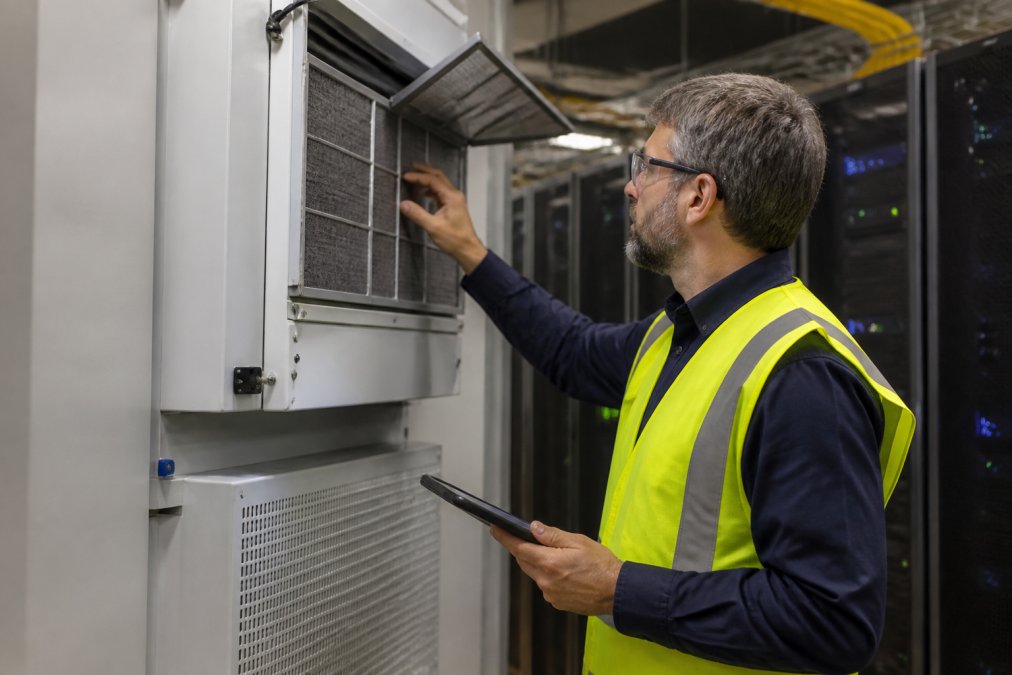
Preventative maintenance is the most consistently undervalued lever in improving energy efficiency in cooling systems. A cooling unit with fouled coils, a low refrigerant charge, or a failing fan motor can consume significantly more energy while delivering less cooling.
| Task | Frequency | DIY or Professional |
|---|---|---|
| Check supply and return air temperatures | Monthly | DIY |
| Inspect and clean air filters | Monthly | DIY |
| Verify thermostat set points and schedules | Monthly | DIY |
| Check for unusual noise or vibration | Monthly | DIY |
| Inspect condensate drain lines | Quarterly | DIY / Professional |
| Clean evaporator and condenser coils | Quarterly | Professional |
| Check refrigerant charge and pressure | Quarterly | Licensed professional |
| Inspect electrical connections and contactors | Quarterly | Professional |
| Full system performance test and log | Annual | Professional |
| Verify economiser operation and controls | Annual | Professional |
| Review energy consumption trends | Annual | DIY with data tools |
DIY Checks You Can Run Monthly
Monthly checks do not require specialist tools or licences. Your facilities team should record supply and return air temperatures, inspect air filters, walk the hot and cold aisles for hot spots using a handheld infrared thermometer, verify blanking panels are in place, and check that thermostat set points remain at baseline. These checks take under 30 minutes per unit and catch the majority of developing issues before they escalate.
Professional Service Tasks (Quarterly and Annual)
Refrigerant handling in Australia is governed by the Australian Refrigeration Council licensing and regulatory requirements, which requires that refrigerant checks, top-ups, and recovery be performed by a licensed refrigerant handling technician. Quarterly professional service should include coil cleaning, electrical inspection, refrigerant pressure verification, and a review of control sequences. Annual service should encompass a full performance test against the unit's rated specifications, economiser verification if applicable, and a review of energy consumption data against baseline.
Smart Monitoring, Zoning and ROI of Cooling System Upgrades
Smart monitoring transforms cooling management from reactive to predictive. The EkkoSense EkkoSoft Critical platform, available through Treske, uses 3D visualisation and advanced sensing to map thermal and power conditions across a data centre floor, supporting capacity planning, predictive maintenance, and energy optimisation.

Zoning is the logical complement to monitoring. Rather than conditioning an entire floor to the same set point, zoning allows different areas to be managed independently based on actual load density. Smart sensors feed zone-level data to control systems that adjust airflow and cooling output accordingly, reducing total energy consumption without compromising thermal comfort.
The ROI case for monitoring and zoning upgrades is typically strong. The Green Building Council of Australia guidance on energy efficiency in commercial buildings notes that monitoring-led optimisation programmes consistently identify energy reduction opportunities that would not be visible through manual inspection alone. Many operators see meaningful returns within 12 to 24 months.
Passive Cooling, Insulation and Building Envelope Improvements
Passive cooling reduces the heat load that mechanical systems must manage, which is a more fundamental form of improving energy efficiency in cooling systems than optimising the systems themselves. For data centres and server rooms, the most common passive improvements are thermal insulation of walls and ceiling, sealing penetrations and cable entry points, window management with reflective film or external shading, and raised floor plenum sealing.
For facilities planning a significant upgrade, a formal energy audit is the right starting point. The Australian Building Codes Board guidance on energy efficiency in commercial buildings sets the minimum performance standards and provides the framework for understanding where a facility sits relative to best practice.
Improving Energy Efficiency in Cooling Systems: Where to Start
Start with airflow. Fix containment, install blanking panels, and seal floor penetrations before spending anything on new equipment. These interventions cost little and often reveal that existing cooling capacity is adequate once hot air recirculation is eliminated.
Next, audit your maintenance history. If coils have not been cleaned in over six months, schedule professional service before drawing conclusions about system performance. Then assess your monitoring capability. If you cannot see real-time temperature and humidity at rack level, sensor infrastructure and platforms like EkkoSoft Critical give you the data needed to make confident decisions about set points, zoning, and equipment sizing.
Finally, evaluate equipment. If your cooling units are fixed-speed, more than ten years old, or significantly oversized for current load, the case for inverter-driven replacements or modular upgrades becomes compelling.
| Intervention | Effort | Energy Impact | Typical Payback |
|---|---|---|---|
| Blanking panels and aisle sealing | Low | Moderate | Weeks to months |
| Thermostat optimisation | Low | Moderate | Immediate |
| Preventative maintenance programme | Low-Medium | Moderate to high | Ongoing |
| Smart monitoring and zoning | Medium | High | 12-24 months |
| Inverter-driven cooling unit upgrade | High | High | 2-5 years |
| Economiser / free cooling integration | High | Very high | 3-6 years |
| Building envelope improvements | Medium-High | Moderate | 2-4 years |
Cooling inefficiency is one of the most costly and most fixable problems in critical infrastructure. Whether you are managing a single server room or a multi-site data centre estate, the path to lower energy consumption and higher resilience runs through the same fundamentals: containment, maintenance, monitoring, and the right equipment for the actual load. Treske Pty Limited brings an agnostic approach to cooling infrastructure design and supply, meaning recommendations are based on what works for your specific environment, not on vendor preference. With precision cooling products from Vertiv and Stulz, monitoring platforms from EkkoSense and Schneider Electric, and expert commissioning and maintenance support across Australia and New Zealand, Treske gives you the full stack needed to make sustainable efficiency gains. Visit us today to discuss your cooling optimisation programme.
Frequently Asked Questions
Which cooling technique is most energy efficient for data centres?
Precision air conditioning with inverter-driven compressors combined with hot/cold aisle containment consistently delivers the best results for data centres. Adding an economiser mode, which uses ambient air or water-side free cooling when outdoor temperatures allow, can reduce mechanical cooling hours significantly. For smaller rooms, modular precision cooling units sized correctly to the actual heat load outperform oversized comfort air conditioning units that cycle on and off inefficiently.
How does regular maintenance impact cooling system energy consumption?
Poorly maintained cooling systems can consume 20-30% more energy than a well-serviced equivalent. Dirty coils reduce heat exchange efficiency, low refrigerant levels force the compressor to work harder, and blocked filters restrict airflow. A structured HVAC preventative maintenance programme, covering monthly filter checks and quarterly refrigerant and coil inspections, keeps the system operating at its rated efficiency and extends equipment life, reducing both operational costs and unplanned downtime.
Are modular cooling systems more efficient for small server rooms?
Yes, in most cases. Modular precision cooling units are designed to match the specific heat load of a small server room, avoiding the energy waste of oversized systems. They also support zoning, so you only cool the space that needs it. Units like the Vertiv Liebert SRC-G and the Stulz MiniSpace EC series are engineered for IT environments, providing precise temperature and humidity control that comfort air conditioning simply cannot match at comparable energy consumption levels.
How do I calculate the energy savings of a cooling system upgrade?
Start with your current system's power draw in kilowatts and your annual run hours, then multiply by your electricity tariff to get a baseline cost. Compare that against the rated efficiency (COP or EER) of the proposed replacement. Software platforms such as EkkoSoft Critical can model your facility's thermal load and project savings before you commit to hardware. A typical precision cooling upgrade in a small-to-medium data centre pays back within two to four years through reduced electricity consumption alone.
This article was written using GrandRanker