


Table of Contents
- What makes scalable rack infrastructure essential for high-density workloads
- High-density data centre cooling solutions that integrate with rack design
- Vendor-agnostic data centre design: why flexibility matters
- Future-proofing critical infrastructure through modular rack systems
- Key specifications for high-density rack deployments
- Selecting the right infrastructure partner for your facilities
- Conclusion
- Frequently Asked Questions
Last Updated: September 3, 2026
What makes scalable rack infrastructure essential for high-density workloads
Scalable rack infrastructure enables organisations to deploy, manage, and expand computing resources efficiently within constrained physical spaces. Modern data centres face relentless pressure: AI clusters demand unprecedented power density, GPU-accelerated computing requires sophisticated thermal management, and future workloads remain unpredictable. A properly designed rack system anticipates these demands and adapts without requiring complete infrastructure overhauls.
The challenge isn't just fitting more equipment into existing space, it's maintaining uptime, managing heat dissipation, distributing power reliably, and preserving the ability to scale when demand shifts. High-density workloads generate exponential thermal stress, and traditional rack layouts fail under this pressure. A single miscalculation in airflow optimisation or power distribution can cascade into facility-wide failures.
At Treske Pty Limited, organisations treating rack infrastructure as an afterthought typically face three critical failures: thermal hotspots that throttle performance, power distribution bottlenecks that limit capacity, and inflexible designs that force costly retrofits.
High-density data centre cooling solutions that integrate with rack design
Thermal management is no longer optional, it's the primary constraint limiting facility density. Traditional in-row cooling approaches fail catastrophically when you pack 40+ kilowatts into a single rack, causing hot aisles to become furnaces and equipment to throttle at 35°C inlet temperatures.
Liquid cooling integration represents the most pragmatic path forward for high-density deployments. Direct-to-chip liquid cooling removes heat at the source, reducing thermal load on facility cooling systems and allowing power density to increase without proportional cooling infrastructure costs.
Effective design layers liquid cooling where density peaks whilst maintaining air cooling where traditional servers remain. Rack-level cooling provides precise temperature control at the equipment level, reduces strain on facility cooling systems, and enables retrofit without complete redesign.
Thermal management best practices for data centre infrastructure emphasise that effective cooling design must account for both current power density and realistic growth projections. Undersizing cooling capacity creates immediate bottlenecks; oversizing wastes operational budget.
Vendor-agnostic data centre design: why flexibility matters
Vendor lock-in manifests in three distinct ways within high-density infrastructure, each with measurable operational and financial consequences.
Proprietary power distribution architectures force organisations into single-vendor ecosystems. When a major PDU manufacturer faced production delays in 2023, facilities locked into their ecosystem had no alternative source for replacement modules, forcing extended downtime or expensive emergency procurement. Vendor-agnostic design means your power distribution framework accepts PDUs conforming to IEC 60309 industrial connectors and standard 3-phase/single-phase voltage configurations, allowing you to source from multiple manufacturers, Eaton, Schneider Electric, Vertiv, Raritan, without redesigning the rack's electrical backbone.

Cooling system lock-in operates similarly. Facilities built around a single vendor's liquid cooling loops become dependent on that vendor for maintenance, repairs, and expansion. Vendor-agnostic cooling design uses industry-standard interfaces: ISO 4401 (CETOP) ported manifolds for liquid systems, standard 230V/400V power inputs for air-cooled units, and open-protocol monitoring (SNMP, Modbus) rather than proprietary management software.
Management and monitoring software lock-in creates the most persistent dependency. Vendor-agnostic approaches use open standards: IPMI (Intelligent Platform Management Interface) for server hardware, SNMP (Simple Network Protocol) for network-attached devices, and Modbus/BACnet for building systems integration. This allows you to deploy monitoring solutions from multiple vendors simultaneously, avoiding single points of failure in visibility and control.
Implementation requires discipline in the design phase. Rather than accepting a vendor's "complete solution," specify requirements using industry standards, then evaluate products against those standards. A 42RU rack frame should accommodate PDUs with IEC 60309 connectors regardless of manufacturer. Cooling systems should integrate via standard power inputs and open monitoring protocols.
The cost of vendor-agnostic design is real: it requires more detailed specification work upfront and more rigorous testing during commissioning. However, operational benefits compound over time. You can upgrade individual components without cascading redesigns, negotiate pricing with multiple suppliers, and respond to supply chain disruptions by sourcing from alternative manufacturers.
IEC 60309 industrial connectors and power distribution standards define the electrical specifications that enable power distribution equipment from different manufacturers to work together reliably.
Future-proofing critical infrastructure through modular rack systems
Future-proofing is impossible, but future-readiness is achievable through modular design. A modular rack system accepts new equipment types without requiring redesign of the entire infrastructure stack. The core structure, the rack frame, power distribution framework, cooling backbone, remains stable whilst components swap out as technology advances.
Greenfield modular design is straightforward: you specify modular architecture from inception, design power distribution for future scaling, and implement cooling systems with expansion capacity. A new facility typically includes flexible mounting options, modular power distribution scaling from 10kW to 50kW per rack without frame replacement, thermal design working with both air and liquid cooling, and cabling infrastructure with sufficient density for future interconnect standards.
Retrofit modularity is substantially more complex. Existing facilities typically have fixed rack frames designed for 10-15kW per rack now requiring 30-40kW, power distribution systems at capacity, undersized cooling systems, and congested cable trays.
Retrofitting for modularity requires:
Staged power distribution upgrades. Rather than replacing the entire facility's electrical infrastructure simultaneously, modular retrofit approaches add new power distribution capacity in phases. You might upgrade one row at a time, installing new modular PDUs alongside existing systems, then gradually migrating workloads.
Cooling system layering. Legacy facilities often rely on room-based air conditioning insufficient for high-density racks. Modular retrofit cooling means adding in-row or rack-level cooling units without removing existing facility cooling. This creates a hybrid approach where legacy air-cooled equipment continues using facility cooling whilst new high-density racks use localised cooling.
Cabling infrastructure expansion. Existing cable trays are often at capacity. Modular retrofit designs often include vertical cable management systems that maximise existing space, allowing higher-density cabling without new infrastructure.
Equipment replacement strategy. Retrofit modularity requires honest assessment of which legacy equipment can coexist with new high-density systems and which must be replaced.
Retrofit projects typically extend 12-24 months, with workloads migrated in phases to maintain uptime. This extended timeline requires careful project management and realistic assessment of what can be upgraded in-place versus what requires replacement.
Infrastructure modernisation strategies for data centre operators highlight that modular retrofit approaches reduce total cost of ownership by extending asset lifespan and reducing forced replacement cycles.
Key specifications for high-density rack deployments
High-density deployments require precision in multiple dimensions simultaneously. Power density, thermal capacity, and physical space constraints must align or the entire system fails.
Power specifications form the foundation. A high-density rack typically draws 30-50 kilowatts, with some GPU-intensive deployments exceeding 60kW per rack. This power must be distributed reliably through power distribution units that provide metered monitoring and circuit protection. The APC Rack PDU 2G Metered Series provides real-time power consumption visibility at the outlet level, enabling precise load balancing and preventing circuit overloads.
For organisations requiring modular scaling, the Eaton 93PM 3-Phase Modular UPS offers capacity from 30kVA to 500kVA with hot-swappable power modules, allowing incremental capacity additions as demand grows.

Thermal specifications must account for both peak operating temperatures and realistic ambient conditions. High-density racks generate inlet air temperatures of 30-35°C under normal operation. Equipment rated for 40°C inlet temperatures operates near thermal limits. Undersizing cooling capacity by even 10 percent creates equipment throttling and reduced performance.
Cabling density is the constraint most facilities underestimate. High-density deployments require high-speed interconnects: 25GbE, 40GbE, or 100GbE Ethernet. Insufficient cabling pathways force inefficient routing, creating airflow obstructions and thermal hotspots.
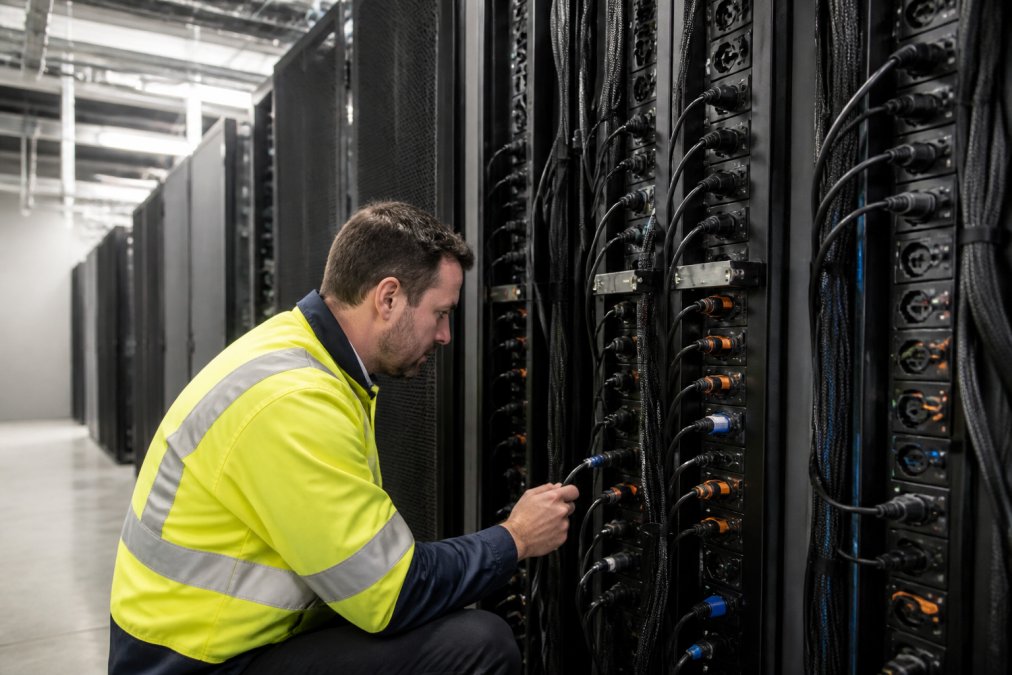
Redundancy specifications define how the system handles component failures. Mission-critical facilities require N+1 or N+2 redundancy in power distribution and cooling. The Liebert APM Plus 3-Phase Modular UPS supports parallel configurations with distributed module control, enabling true N+1 redundancy where each power module operates independently with automatic failover.
Space efficiency specifications determine how much compute density you can achieve. A 42RU rack provides approximately 2 cubic metres of usable space. High-density deployments might pack 20-30 servers into this space, requiring careful attention to cable management, power distribution positioning, and cooling airflow patterns. The Vertiv VE Series Server Racks and Schneider Electric NetShelter SX enclosures both provide modular cable management systems that maintain airflow integrity under extreme density conditions.
Selecting the right infrastructure partner for your facilities
Selecting an infrastructure partner is fundamentally different from selecting a vendor. A vendor sells products; a partner designs systems, manages implementation, and optimises performance over time.
Critical evaluation criteria centre on three dimensions: technical depth, operational continuity, and alignment with your facility's specific constraints.
Technical depth means the partner understands high-density infrastructure at a detailed level. They should articulate why specific power distribution architectures work better than others, how to calculate thermal loads accurately, and how to design for future workload uncertainty.
Operational continuity matters because infrastructure failures create cascading consequences. A partner should provide commissioning services that verify every system component functions correctly before handover, ongoing maintenance and monitoring to ensure equipment remains within optimal operating parameters, and emergency support for critical system failures.
Treske Pty Limited provides comprehensive critical infrastructure solutions: design, supply, installation, and ongoing maintenance. Our agnostic approach means we design systems around your specific needs rather than pushing a particular vendor's ecosystem. We serve data centre managers, facility managers, infrastructure leads, and healthcare institutions across Australia and New Zealand, delivering end-to-end resilience for mission-critical facilities.
Alignment with constraints requires honest assessment of your current situation. Are you building a greenfield facility or retrofitting existing space? Do you have legacy equipment that must remain operational during upgrades? A partner should ask these questions directly and design accordingly.
Conclusion
High-density, future-proof facilities require infrastructure designed with precision and flexibility. The organisations succeeding today invested in scalable rack infrastructure, vendor-agnostic design, and modular systems that adapt as technology evolves.
Treske Pty Limited specialises in this challenge. We design, supply, and install critical infrastructure solutions tailored to your facility's specific operational needs. Our agnostic approach means you get best-of-breed components rather than vendor lock-in. Our maintenance and commissioning services ensure systems remain optimised and resilient. Get started with Treske Pty Limited and build infrastructure that scales with your ambitions.
Frequently Asked Questions
What are the key requirements for high-density rack infrastructure?
High-density rack infrastructure demands robust power delivery, advanced thermal management, and careful cable organisation. Power density requirements often exceed 10 kW per rack in modern deployments. Effective airflow containment, whether through hot-aisle or cold-aisle strategies, prevents thermal recirculation. Rack layout must accommodate equipment from multiple vendors whilst maintaining consistent spacing, grounding, and load distribution. Capacity planning tools help monitor available space, power, and cooling resources to prevent bottlenecks.
How does vendor-agnostic data centre design reduce operational risk?
Vendor-agnostic design means your infrastructure works with equipment from any manufacturer, avoiding lock-in and reducing costs. This approach allows you to select the best-performing components for each application rather than standardising on a single brand. It simplifies upgrades, enables competitive procurement, and protects your investment if a preferred vendor discontinues a product line. Modular UPS systems like the Liebert APM Plus and Eaton 93PM support this flexibility by integrating seamlessly with diverse equipment ecosystems.
What should you look for in a data centre infrastructure installation partner?
Choose a partner with proven experience in your industry, healthcare, government, or enterprise IT environments have distinct resilience requirements. Verify their track record with zero-downtime upgrades and commissioning. They should offer comprehensive services: design, supply, installation, and ongoing maintenance. Ask about their approach to capacity planning, energy efficiency reporting, and whether they maintain relationships with multiple equipment manufacturers. References from similar-sized facilities in your region are invaluable.
Why is power and cooling integration critical for high-density racks?
Power and cooling are interdependent: inefficient cooling forces higher fan speeds, consuming more energy; inadequate power distribution creates bottlenecks that prevent optimal equipment placement. Integrated design ensures power distribution units (PDUs) are positioned to minimise cable runs, whilst cooling systems are engineered for the actual heat load of your specific equipment mix. Real-time monitoring via DCIM software like Sunbird or EcoStruxure IT reveals imbalances early, preventing hot spots and unplanned downtime.
This article was written using GrandRanker