

Table of Contents
- What a UPS Preventative Maintenance Service Level Agreement Should Include
- Setting a Risk-Based UPS Maintenance Schedule
- UPS Battery Testing and Replacement Planning
- UPS Emergency Response Time and Restoration Targets
- Coverage Boundaries: Labour, Travel, Parts and Exclusions
- What a UPS Service Report Should Record
- Evaluating Providers and Comparing Maintenance Contracts
- Conclusion
- Frequently Asked Questions
Last Updated: October 12, 2026
What a UPS Preventative Maintenance Service Level Agreement Should Include
A UPS preventative maintenance service level agreement is a written contract that sets out what maintenance a provider will perform on your uninterruptible power supply, how often, how fast they respond when something fails, and what is covered when they arrive.

Most site managers treat this document as paperwork. That is a mistake. The agreement is the only thing standing between a battery string failure and an unplanned outage.
A good agreement answers six questions:
- How often will a technician visit?
- How quickly will someone respond to a fault?
- What battery testing is included?
- Who pays for parts, labour and travel?
- What gets recorded and reported?
- What happens if the provider misses a target?
Get those right and you have a contract worth having. Get them wrong and you have a document that looks reassuring until the day you need it.
Setting a Risk-Based UPS Maintenance Schedule
A fixed calendar schedule suits some sites and wastes money on others. The better approach is to match visit frequency to how much a failure would cost you, and to be able to defend that frequency in writing.
Most guides stop at a table. A table is not a method. What you actually need is a repeatable way to score your own site, because two 100 kVA systems in the same building can justify different cadences.
Score the site before you agree a cadence
Work through these factors and note where your site sits. Each one pushes frequency up or down.
| Factor | Pushes frequency up | Pushes frequency down |
|---|---|---|
| Criticality of load | Life safety, clinical, trading, comms | Non-critical, tolerant of brief loss |
| Redundancy | Single UPS, no bypass, no generator | N+1, dual path, generator-backed |
| Battery chemistry and age | VRLA past mid-life, lithium approaching cycle limit | New string, within first year |
| Environment | Dust, heat, humidity, vibration, coastal air | Clean, temperature-controlled room |
| Load profile | High cyclic load, frequent transfers | Steady, light load relative to rating |
| History | Prior faults, alarms, thermal events | Clean event log |
| Access and monitoring | No remote monitoring, manual checks only | Network card, alerting, trend data |
A common pattern is to start with a default cadence, then adjust one step up or down for every two or three factors that clearly point the same way.
A typical starting range looks like this:
| Site type | Typical visit frequency | Why |
|---|---|---|
| Single small UPS, non-critical load | Annual | Low consequence of failure |
| Office or retail UPS | Semiannual | Moderate load, shared environment |
| Data centre, hospital, utility | Quarterly | High consequence, battery ageing |
| Harsh or dusty environment | Quarterly or more | Faster component degradation |
These are examples only. Your own contract will set the actual terms, and your provider should justify whatever frequency they propose.
What each visit should include, whatever the cadence
Frequency is only half the schedule. The other half is what happens when the technician arrives. Insist the agreement lists the tasks per visit, not just the number of visits.
- Visual inspection of the UPS, batteries, cabling and environment
- Battery voltage, impedance or conductance checks as specified
- Torque verification on terminals and connections
- Alarm and event log review
- Firmware version check and update where the manufacturer permits
- Functional test, transfer test or runtime test at an agreed interval
A quarterly visit that skips battery testing is worth less than an annual visit that includes it.

Build in review points
A schedule set at signing should not be fixed forever. Ask for an annual review where the provider presents trend data, battery readings, alarm history, load changes, and recommends whether the cadence should change. That turns the schedule into a living document rather than a line item.
Whatever cadence you land on, write it into the agreement with the task list attached. "Quarterly visits" on its own is not a schedule, it is a promise to turn up.
UPS Battery Testing and Replacement Planning
Battery testing is the core of any maintenance visit, because batteries are the component most likely to let you down.
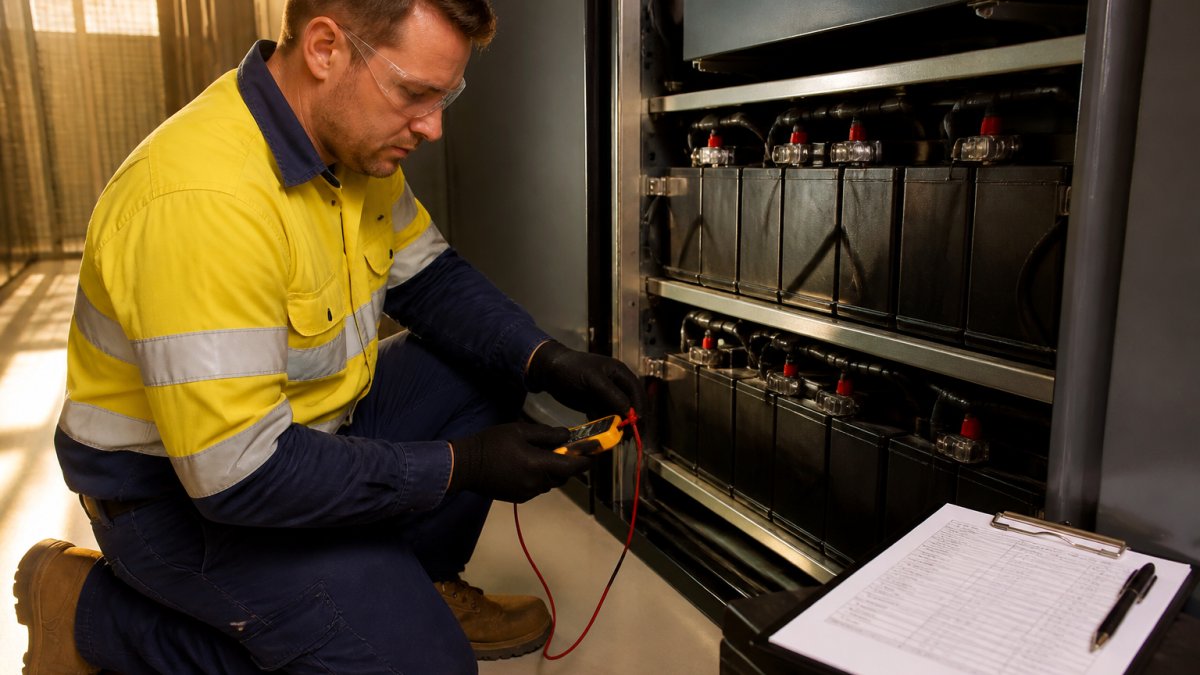
Your agreement should state what testing happens and how results are recorded. Common inclusions:
- Individual battery voltage and string voltage checks
- Physical inspection for swelling, leakage or corrosion
- Terminal torque verification
- Impedance or conductance testing where specified
- Load or runtime testing at an agreed interval
Replacement planning matters just as much. Batteries have a service life, and the agreement should say who decides when a string is replaced and how that decision is documented.
For sites running valve-regulated lead-acid or lithium-ion strings, confirm the provider is trained on your specific battery type. Testing methods differ.
UPS Emergency Response Time and Restoration Targets
Response time and restoration time are not the same thing, and confusing them costs people money. Response time is how long until someone acknowledges and attends.
Typical arrangements separate them:
- Business hours response: attendance within an agreed window during working hours
- After-hours response: a longer window, or a premium tier for faster attendance
- Remote response: monitoring alerts acknowledged before a site visit
The Australian Cyber Security Centre guidance on critical infrastructure resilience is worth reading if your UPS supports systems covered by security-of-critical-infrastructure obligations, because reporting and response expectations can extend beyond the power train itself.
Treske Preventative Maintenance Contract →
Set targets you can actually measure. "Prompt response" is not a target. "Attendance within four business hours" is.
Coverage Boundaries: Labour, Travel, Parts and Exclusions
The cheapest-looking contract is often the one with the most exclusions. Read this section twice, and read it against a comparison table rather than a list.
Compare inclusions side by side
Put two or three quotes next to each other and mark what is in, what is out, and what is capped. The pattern below is common; your own contract will set the actual terms.
| Item | Often included | Often excluded or capped |
|---|---|---|
| Scheduled labour | Included in the visit | Billed hourly beyond an agreed number of hours |
| Emergency labour | Included in business hours | Charged at premium rates after hours |
| Travel | Included within a radius | Charged per kilometre beyond it |
| Batteries | Inspected and tested | Replaced at extra cost, or capped per year |
| Consumables (filters, fans, fuses) | Sometimes included | Often excluded |
| Firmware updates | Checked and applied where permitted | Excluded if manufacturer requires a licence |
| Monitoring | Alerts acknowledged remotely | Full monitoring platform billed separately |
| Reporting | Standard visit report | Trend analysis or dashboard billed separately |
Common exclusions to watch for
- Damage from water, vermin, lightning or unauthorised modification
- Batteries beyond an agreed age or cycle count
- Work outside stated business hours unless a premium tier is purchased
- Consumables such as filters, fans and fuses
- Faults traced to upstream switchgear, generators or building wiring
- Site access delays or escort requirements that extend the visit
Remedies and accountability
A service level agreement without consequences is a wish list. Ask what happens when the provider misses a target.
- Service credits: a defined credit or rebate if response or restoration targets are missed. The mechanism should be written, not implied.
- Escalation path: named contacts and timeframes for raising a missed target, from account manager to operations director.
- Dispute handling: how disagreements about whether a target was met are resolved, and what records count as evidence.
- Exit terms: what happens at the end of the contract, notice periods, and who owns the maintenance records.
Keep the records
Whatever the outcome, you want the maintenance history. Confirm in writing that you receive and retain all service reports, battery test data and firmware records, and that they transfer to you or a new provider on exit.
Treske's preventative maintenance contract includes battery, cooling and UPS maintenance under one agreement, which removes the usual argument about which trade owns which fault.
Compare that against a contract that lists labour and travel as extras. The headline figure means little until you know what sits outside it.
What a UPS Service Report Should Record
A UPS service report is the written record of what the technician found, tested and changed. Without it, you have no evidence the work happened and no trend data to plan against.
A useful report includes:
- Date, time and duration of the visit
- Technician name and licence details
- Environmental readings: temperature and humidity
- Battery voltages, impedance results and torque checks
- Alarms and events found in the UPS log
- Firmware version and any updates applied
Ask for reports in a format you can file and search. Paper reports get lost. A digital record tied to your asset register is far more useful at budget time.
Evaluating Providers and Comparing Maintenance Contracts
Comparing quotes on price alone will mislead you. Two contracts at the same headline figure can differ enormously in what they cover.
Score each provider against the same criteria:
- Response and restoration commitments, with remedies if missed
- Visit frequency and what each visit includes
- Battery testing method and replacement criteria
- Parts, labour and travel coverage
- Reporting format and record retention
- Technician qualifications and licensing
- Escalation process and named contacts
Ask for two references from sites similar to yours. A hospital should ask for hospital references. A data centre should ask for data centre references.
Then check the exit terms. What happens at the end of the contract, and who owns the maintenance records?
Conclusion
The hard part is not writing the agreement. It is finding a provider who will meet it year after year, when the novelty has worn off and the battery strings are ageing.
Treske designs, supplies and installs UPS systems, data centre cooling, PDUs, racks and environmental monitoring across Australia and New Zealand.
Visit us today to discuss a maintenance agreement built around your actual risk profile.
Frequently Asked Questions
What should a UPS preventative maintenance service level agreement include?
A complete agreement sets out visit frequency, the inspection and testing tasks performed at each visit, battery testing methods, response and restoration targets, parts and labour coverage, exclusions, and reporting requirements. It should also name the escalation contacts on both sides and state how performance is measured. Ask for the scope of works in writing before signing, and check your own contract for the exact inclusions, because coverage varies between providers and equipment types.
How often should a UPS receive preventative maintenance?
Typical programs run quarterly or semiannual visits, with annual visits sometimes used for smaller units in low-risk locations. A risk-based UPS maintenance schedule weighs load criticality, battery type and age, site environment, and manufacturer guidance. Sites with high fault risk or older VRLA batteries often need more frequent inspection. Treat these as example ranges only and confirm the required interval in your own contract.
What is the difference between response time and restoration time in a UPS SLA?
Response time is how quickly a provider acknowledges and starts work on a fault, usually measured from when you log the call. Restoration time is how long until the UPS or battery system is returned to normal operation. A contract may promise a fast response but a much longer restoration window, so read both figures together. Check whether each is measured in business hours or around the clock, since that changes what the commitment means in practice.
What should a UPS maintenance visit report include?
A useful UPS service report records the date and duration of the visit, the tasks completed, battery voltage and condition readings, torque checks on terminals and interconnections, alarm or event logs, environmental readings, and any parts replaced. It should also flag open issues, recommended follow-up work, and the next scheduled visit. Keep these reports in your asset records so you can track battery health trends and plan replacement before runtime drops.