

Table of Contents
- What Outlet Level Monitoring Actually Measures
- Identifying Zombie Servers With Per-Outlet Power Data
- Remote Power Cycling Benefits for 24/7 Facilities
- Data Centre Power Capacity Planning With Granular Metrics
- Preventing Circuit Overloads and Improving PUE
- Integrating Outlet Level Monitoring With DCIM and Billing
- Conclusion
- Frequently Asked Questions
Last Updated: October 4, 2026
What Outlet Level Monitoring Actually Measures
Outlet level monitoring is the practice of measuring power consumption at each individual outlet on a rack power distribution unit, rather than at the PDU or rack as a whole. For data centre managers, it turns a single aggregate reading into a per-device picture of what is actually drawing power.
That distinction matters more than it first appears. A rack PDU might report a total load of 4.2 kW, which tells you the rack is running. It does not tell you that one server is pulling 40% of that load while three others sit idle. Outlet-level metering captures amperage, voltage and wattage for every connected device, which is the foundation for everything else in this guide.

At Treske Pty Limited, we design and install power, cooling and rack infrastructure for critical facilities, and the single most common gap we see is visibility. Teams know their total draw. They rarely know which outlet is responsible for it.
Inlet Metering vs Outlet Metering: The Practical Difference
Inlet metering measures power where it enters the PDU. Outlet metering measures it where each device connects. Inlet data answers "how much is this rack using?" Outlet data answers "which device is using it, and how much?"
| Capability | Inlet Metering | Outlet Level Metering |
|---|---|---|
| Total rack load | Yes | Yes |
| Per-device consumption | No | Yes |
| Remote outlet switching | No | On switched models |
| Idle asset detection | Not possible | Straightforward |
| Billing-grade allocation | Rack only | Per device |
The practical consequence is simple: inlet metering supports capacity planning at rack level, while outlet metering supports it at device level. Only one of those lets you act on a single server.
Identifying Zombie Servers With Per-Outlet Power Data
Zombie servers are physical machines that still draw power but no longer perform useful work. They are the most expensive form of clutter in a data centre because they consume electricity, cooling and rack space while contributing nothing.
Finding them without outlet data is guesswork. With it, the method is almost mechanical:
- Export outlet-level wattage for every PDU over a 30-day window
- Flag any outlet drawing a steady low load with no variation
- Cross-check flagged outlets against your asset register and monitoring tools
- Confirm with the application owner before decommissioning
- Power down remotely and record the reclaimed capacity
A server idling at a few hundred watts for a month with flat consumption is a strong candidate. Servers doing real work show variance: CPU spikes, backup windows, batch jobs. Flat lines usually mean forgotten hardware.
Remote Power Cycling Benefits for 24/7 Facilities
Remote power cycling lets you reboot a locked-up device by switching its outlet off and on through a network connection, without sending anyone to site. For facilities that run continuously, that capability changes how you handle routine faults.
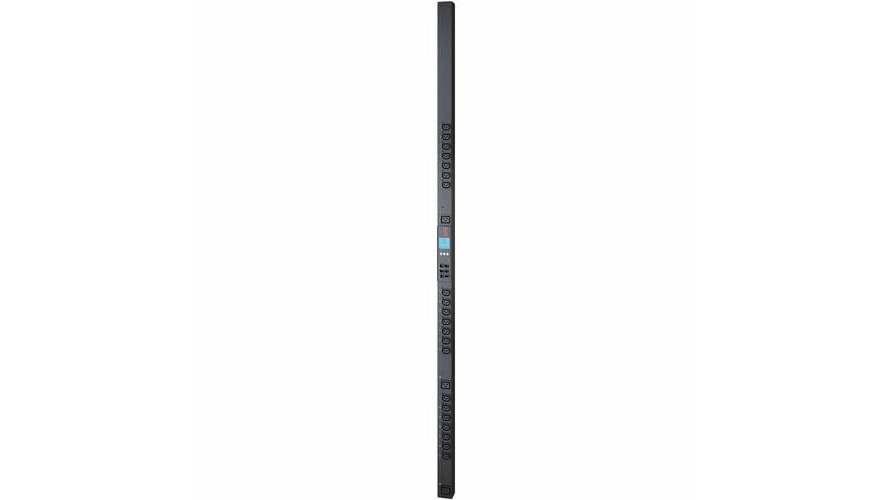
A switched PDU such as the APC NetShelter Metered-by-Outlet with Switching Rack PDU supports exactly this: individual outlet control, power sequencing delays, and real-time current metering with user-defined alarms. The practical benefits stack up quickly:

- Faulty device recovery happens in minutes, not hours
- No after-hours site access or escort required
- Power sequencing prevents inrush current tripping the circuit on restart
- Unused outlets can be disabled to prevent unauthorised equipment
The sequencing detail is the one people overlook. Powering up a full rack simultaneously can trip a breaker on inrush alone. Defining a startup order avoids that entirely.
Data Centre Power Capacity Planning With Granular Metrics
Capacity planning with outlet data works from measured consumption rather than nameplate ratings. That is a meaningful shift, because nameplate figures describe worst-case draw, not real draw.
Most servers run well below their rated maximum. When you plan capacity from nameplate numbers, you reserve headroom you never use and defer upgrades you do not need. Outlet-level data replaces estimates with actual figures, which lets you:
- Calculate true spare capacity per rack before adding hardware
- Place new equipment where headroom genuinely exists
- Justify or defer capital expenditure with measured evidence
- Track growth trends per device over time
This is where outlet level monitoring pays for itself fastest. A rack you believed was at 80% capacity may be running at 45% in practice, and that difference can delay a costly expansion by a year or more. Gaining this level of granular visibility into power consumption patterns mirrors the efficiency gains achieved through home energy monitoring systems, where identifying idle loads is the primary driver of long-term operational savings.
Preventing Circuit Overloads and Improving PUE
Overload prevention and efficiency improvement both depend on the same input: knowing what each outlet draws, in real time. Power usage effectiveness, or PUE, is the ratio of total facility power to IT equipment power, and the closer that ratio sits to 1.0, the more efficiently the facility runs (Large data centers are mostly more efficient, analysis confirms).
Outlet metering improves both in concrete ways:
APC NetShelter Metered-by-Outlet with Switching Rack PDU, 2G, 0U, 20A/208V →
- Alerting thresholds trigger before a circuit reaches its breaker limit
- Load balancing across phases becomes measurable rather than estimated
- Stranded capacity is identified and reclaimed
- Cooling demand can be matched to actual IT load rather than assumed load
The overload protection is the more urgent benefit. A circuit breaker that trips takes down everything on that circuit. User-defined alarms that warn at a set amperage threshold give you time to move a load before that happens. For high-density racks, where a single blade chassis can shift consumption significantly, that warning window is essential.
Integrating Outlet Level Monitoring With DCIM and Billing
Outlet-level data becomes far more useful once it reaches your data centre infrastructure management platform. DCIM software pulls PDU metrics over SNMP or a web interface and combines them with asset, environmental and capacity data in one view.
Integration typically delivers three things:
Real-time analytics. Power metrics per outlet, per rack and per row, refreshed continuously rather than collected manually.
Environmental monitoring. Many switched PDUs include a temperature and humidity sensor port, so thermal data arrives alongside power data. That pairing supports thermal management decisions grounded in actual conditions.
Billing transparency. For colocation and managed service providers, per-outlet consumption supports accurate chargeback to customers. Billing disputes drop sharply when the customer can see their own metered usage.
A word on security. Networked PDUs are management interfaces with the ability to cut power to critical equipment, which makes them a genuine attack surface. Use two-level password security, enable remote authentication where supported, keep firmware current, and place PDU management traffic on a segregated management VLAN. A PDU with default credentials is a liability, not an asset.
For smaller deployments or edge sites, a compact option such as the Aten 4 Port 1U Smart PDU provides outlet control and remote power management in a 1U form factor, with two-level password security and RADIUS authentication support.
Conclusion
The gap between knowing your total power draw and knowing which device is responsible for it is where most efficiency and capacity gains hide. Closing that gap takes capable hardware, correct configuration, and a plan for what to do with the data once it arrives.
Treske Pty Limited designs, supplies and installs power, cooling and rack infrastructure for critical facilities, with an agnostic approach to technology that lets us recommend what actually fits your site rather than what suits a single vendor. Our teams handle UPS installation, rack and stack, and preventative maintenance across Australia and New Zealand, backed by commissioning and site acceptance testing that confirms the installation performs as designed.
Get started with Treske Pty Limited and turn your power data into decisions you can act on.
Frequently Asked Questions
What is the difference between inlet and outlet-level power monitoring?
Inlet metering measures total power drawn by the whole PDU, giving you one number for everything plugged into it. Outlet level monitoring measures each socket separately, so you can see exactly what a single server, switch or storage array is drawing. That granularity matters when you need to identify a failing power supply, spot an idle device, or work out which circuit is close to tripping. Inlet data tells you the rack is busy; outlet data tells you which piece of IT equipment is responsible.
How does outlet-level monitoring improve data centre energy efficiency?
Per-outlet power metrics expose devices that draw current without doing useful work, often called zombie servers. Once you can see a server pulling 180W while sitting at near-zero utilisation, you can decommission it or move it to a lower-density zone. Fewer active loads means less heat, which reduces cooling demand and improves power usage effectiveness. The same data supports alerting thresholds, so you catch a runaway process or a stuck fan before it becomes an outage or an inflated energy bill.
Can outlet-level monitoring help identify stranded power capacity?
Yes. Stranded capacity is power you have already paid for but cannot use because no one knows where the headroom sits. Outlet-level metering shows the actual amperage drawn at each socket against the circuit breaker rating, so you can see which racks have spare capacity and which are effectively full. That visibility supports data centre power capacity planning across a site, letting you defer a new circuit or a UPS upgrade until the existing infrastructure is genuinely at its limit.
Does outlet-level monitoring support remote power cycling of equipment?
It does when paired with a switched PDU. Remote power cycling benefits include rebooting a locked-up server, router or camera from a browser or SNMP interface without sending a technician to site, which matters for edge cabinets and unmanned facilities. Power sequencing delays let you define the order devices power up after an outage, avoiding the inrush current that trips a circuit breaker. User-defined alarms also warn of a potential overload before critical IT equipment fails.